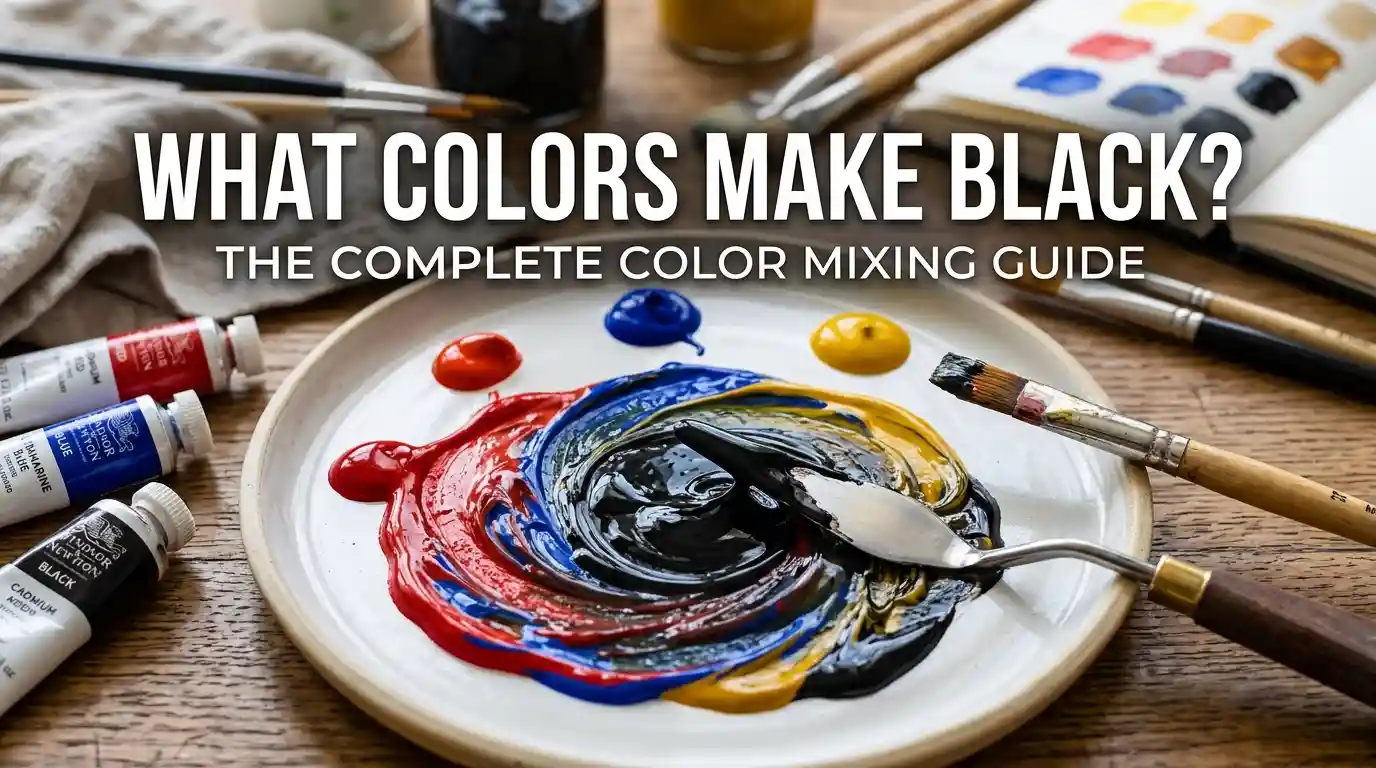
What Colors Make Black? The Complete Color Mixing Guide
Ever wondered what colors make black, especially after your “black” mix turned out looking more like muddy brown or dark gray? You’re not alone — black is one of the most misunderstood colors to mix by hand, because pigments don’t behave the same way light does.
Main takeaway: The most reliable way to mix black with paint is combining red, blue, and yellow in roughly equal parts, or mixing two complementary colors — like blue and orange, or red and green — at their darkest, most concentrated saturation. Neither method gives you a pure jet black, but both get you close enough for most painting and design work.
By the end of this guide, you’ll know how to mix black step by step, how to build a true digital black with hex and RGB codes, and why your homemade black keeps turning out brown instead of black.
What Is Black?
Technically speaking, black isn’t a color on the traditional color wheel at all — it’s the complete absence of reflected light, which is different from how pigments actually work. In paint and pigment terms, black is best understood as the darkest possible shade, created by combining colors until almost no light bounces back off the mixture.
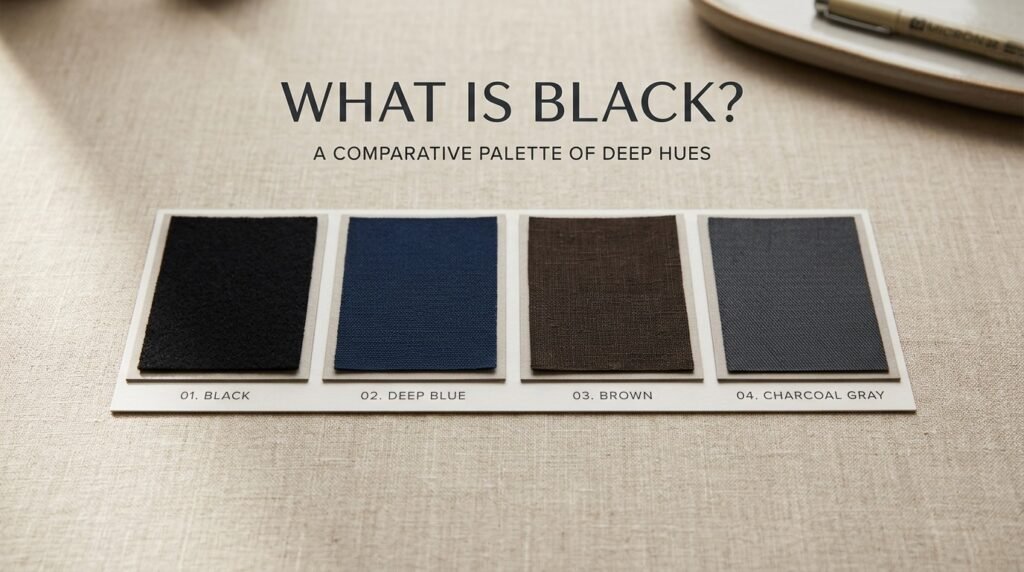
Here’s a quick breakdown of black’s core traits:
- Warm or cool: Neutral, though it can lean warm (brownish-black) or cool (blue-black) depending on the mix
- Color wheel position: Not on the wheel itself — it sits at the center as the darkest possible shade
- Common associations: Elegance, power, mystery, formality, minimalism
- Standard hex code: #000000
- RGB values: 0, 0, 0
Because black isn’t a true hue, most how to make black questions really come down to one challenge: getting a mix dark enough and neutral enough that it doesn’t read as brown, navy, or dark green instead.
What Colors Make Black?
Here’s the direct answer to what colors make black: mix all three primary colors in roughly equal, concentrated amounts.
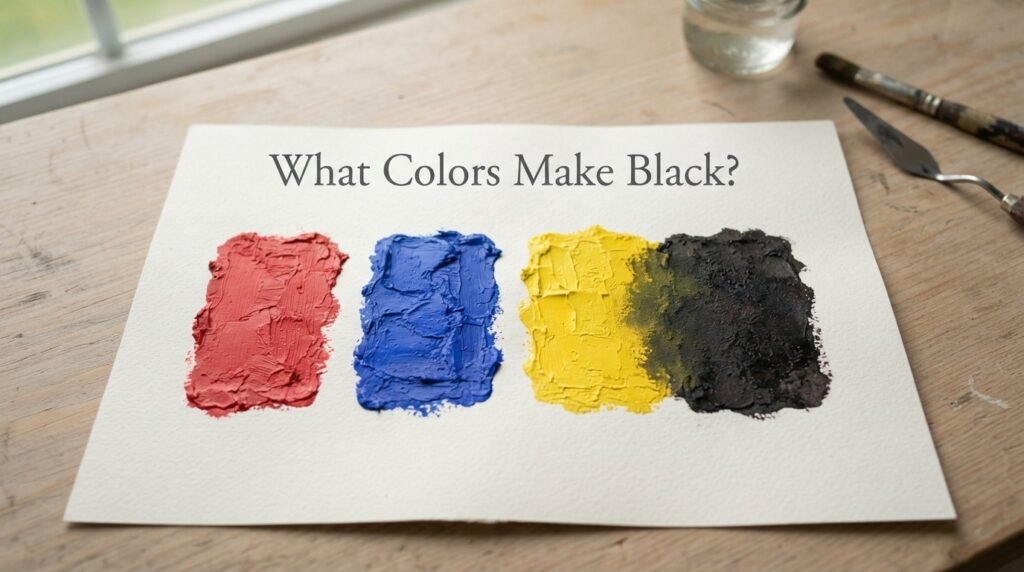
- 1 part red
- 1 part blue
- 1 part yellow
When mixed thoroughly and in deep enough concentration, these three primaries cancel each other out and produce a very dark, near-black tone. If you’d rather work with complementary pairs, mixing blue and orange or red and green in roughly equal, saturated amounts also produces a dark neutral close to black, since complementary colors neutralize each other’s saturation.
Beginner Tip: If your black looks more brown than black, add a touch more blue. If it looks too blue or cool, add a small amount of red or a tiny drop of orange to warm it back up.
Step-by-Step: How to Mix Black in Paint
Learning how to make black color with real paint works best when you build it up in layers rather than combining everything at once.
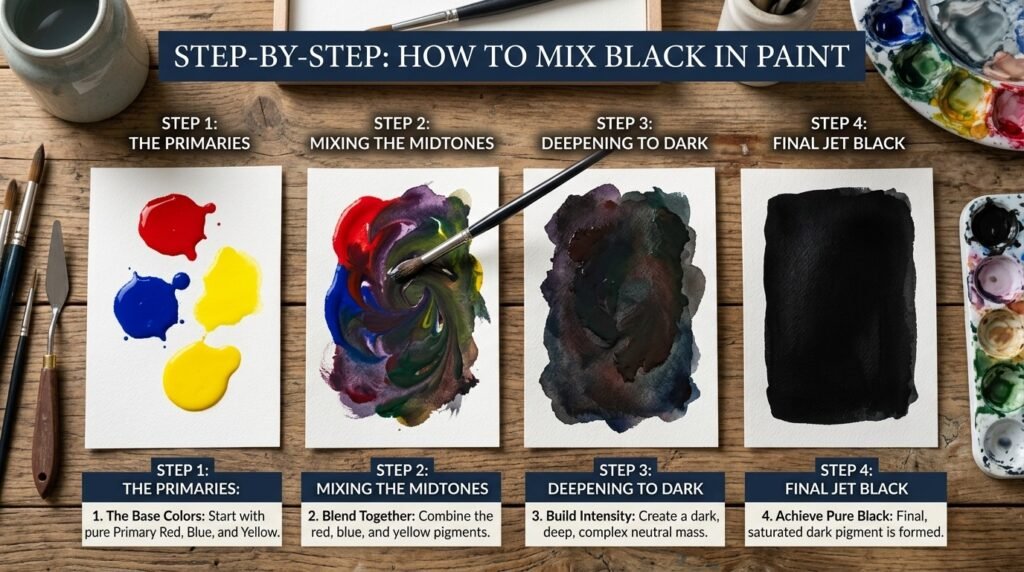
- Start with deep, saturated pigments. Squeeze out 1 part red, 1 part blue, and 1 part yellow — use the most concentrated versions of each you have.
- Mix blue and red first. This creates a dark purple base, which is closer to black than starting with yellow.
- Add yellow gradually. Mix in the yellow a little at a time, stirring fully after each addition.
- Check the tone. You’re aiming for a deep, neutral near-black. Stop as soon as the mix stops looking purple or brown and reads as black.
- Adjust lighter or darker. To lighten, add tiny amounts of white to create gray rather than black. To darken further, add a touch more blue rather than more of all three colors.
- Adjust warmer or cooler. For a warmer black, add a small amount of red or brown. For a cooler black, lean more heavily on blue.
This approach to making black at home works with acrylics and oils fairly reliably, though watercolor tends to stay more transparent and rarely reaches a true black without a dedicated black pigment.
Black Paint Mixing Chart
Not every “black” needs the same starting ratio. The chart below shows how small shifts in your red-blue-yellow mix create different near-black results, which is useful once you understand what colors make black in theory and want to fine-tune the exact tone.
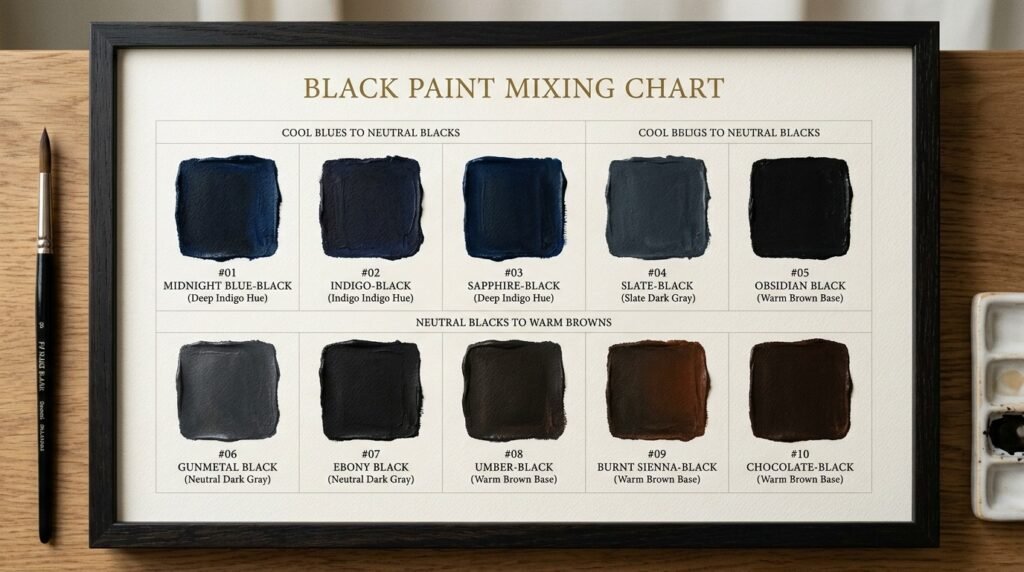
| Red | Blue | Yellow | White | Resulting Shade | Hex Code |
| 1 part | 1 part | 1 part | — | Standard Near-Black | #0D0D0D |
| 1 part | 2 parts | 1 part | — | Blue-Black | #0A0E14 |
| 2 parts | 1 part | 1 part | — | Warm Brown-Black | #1A0F0A |
| 1 part | 1 part | 2 parts | — | Olive-Black | #14140A |
| 1 part | 2 parts | — | — | Deep Indigo-Black | #0B0A1F |
| 2 parts | 2 parts | 1 part | — | Cool Charcoal-Black | #14121A |
| 1 part | 1 part | 1 part | 1 part | Charcoal Gray | #2B2B2B |
| 1 part | 1 part | 1 part | 3 parts | Slate Gray | #6E6E6E |
| Orange + Blue (equal parts) | — | — | — | Neutral Near-Black | #100E0C |
| Red + Green (equal parts) | — | — | — | Deep Forest-Black | #0E1208 |
The clearest pattern in this chart is that blue pushes the mix cooler and darker, while red or yellow in excess pulls it toward brown or olive — so if you want a true, neutral-looking black rather than a warm or cool-tinted one, blue should always be the dominant color in the mix.
How to Make Black With Different Starting Colors
Not everyone has a full set of primaries handy, so here’s a second answer to how to make black using secondary colors instead.
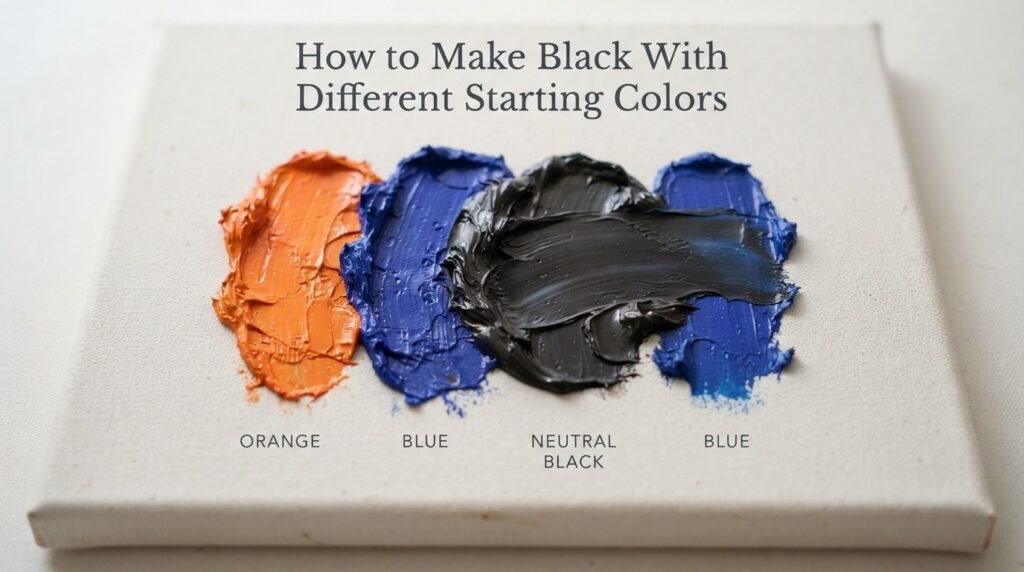
- Orange + Blue: Mix in roughly equal, concentrated parts — this complementary pair neutralizes quickly into a dark, near-black tone.
- Purple + Yellow: Purple already contains red and blue, so adding a small, careful amount of yellow pushes the mix toward black rather than brown.
- Green + Red: Green contains blue and yellow, so mixing in red completes the primary triad indirectly, producing a deep, slightly cooler black.
Each of these paths works for the same reason: complementary colors cancel each other’s brightness and saturation, and with enough pigment concentration, that cancellation pushes the result close to true black rather than a muddy mid-tone.
How to Make Black Digitally (RGB/Hex)
If you’re working in Photoshop, Procreate, or CSS, making black digitally is far more exact than mixing paint, since digital black is simply the complete absence of light rather than a physical pigment blend.
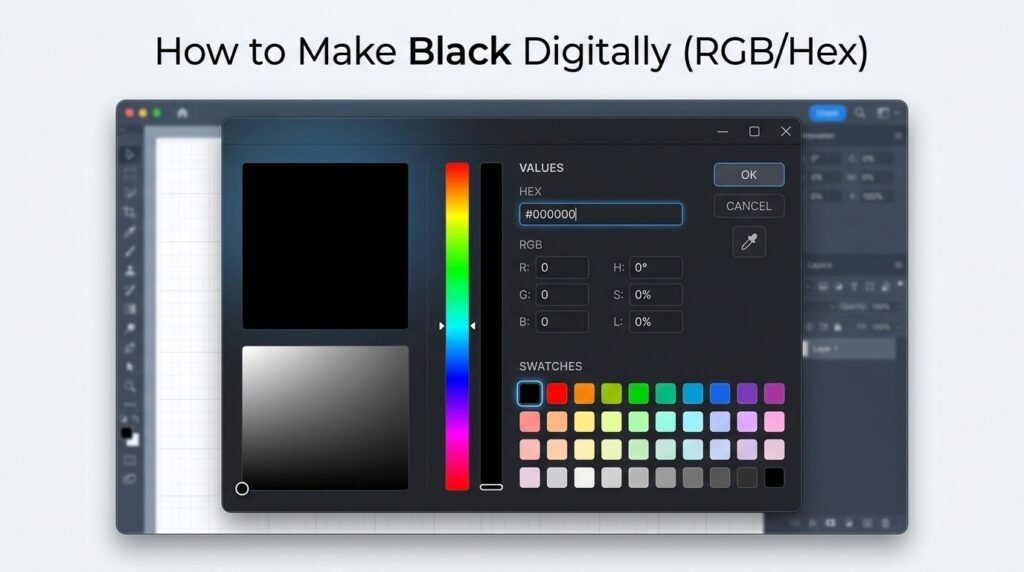
- Standard Black Hex Code: #000000
- RGB Values: R: 0, G: 0, B: 0
- CSS: background-color: #000000; or background-color: black;
To create black digitally, open your color picker and either paste in the hex code directly or set every RGB slider to zero. Many designers actually avoid pure #000000 for large backgrounds since it can look harsh on screen, opting instead for a “soft black” like #0D0D0D or #121212, which still reads as black but feels slightly less stark. Unlike paint, there’s no ambiguity here — pure black digitally is always zero across red, green, and blue.
Common Mistakes When Mixing Black (and How to Fix Them)
Even with the right ratio, how to make black mixes can go wrong in predictable ways. Here are the most common issues:
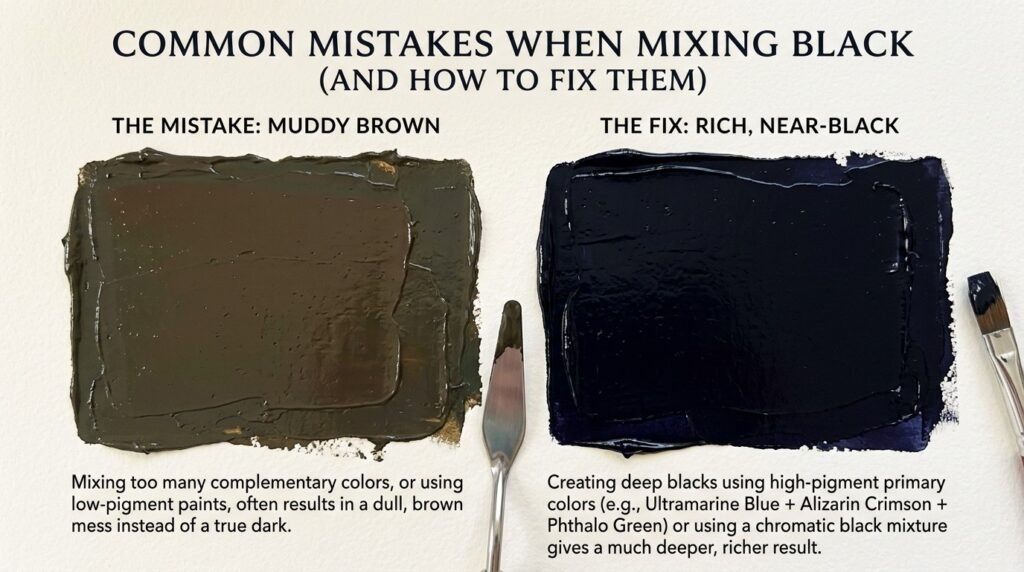
- Turns out brown instead of black: You likely have too much red or yellow relative to blue. Fix it by adding more blue, a little at a time, until the brown tone disappears.
- Turns out too blue or navy: You’ve overloaded on blue. Add a small amount of red or orange to neutralize the excess blue tint.
- Looks gray instead of black: The pigments aren’t concentrated enough, or you’ve added white by accident. Use less water or medium and mix in more pigment rather than diluting further.
- Uneven or streaky black: This usually means the colors weren’t fully blended before adding more. Always mix two colors completely before introducing the third.
Most of these problems come down to rushing the process, which is why experienced painters often say mixing black from primaries is a lot like brewing strong coffee — you can’t shortcut the concentration; you just have to let the colors steep into each other fully before judging the result.
Tips for a Consistent, Vivid Black
Getting the same black twice takes some discipline, especially since hand-mixed black is naturally harder to reproduce than a pre-made tube of black paint.
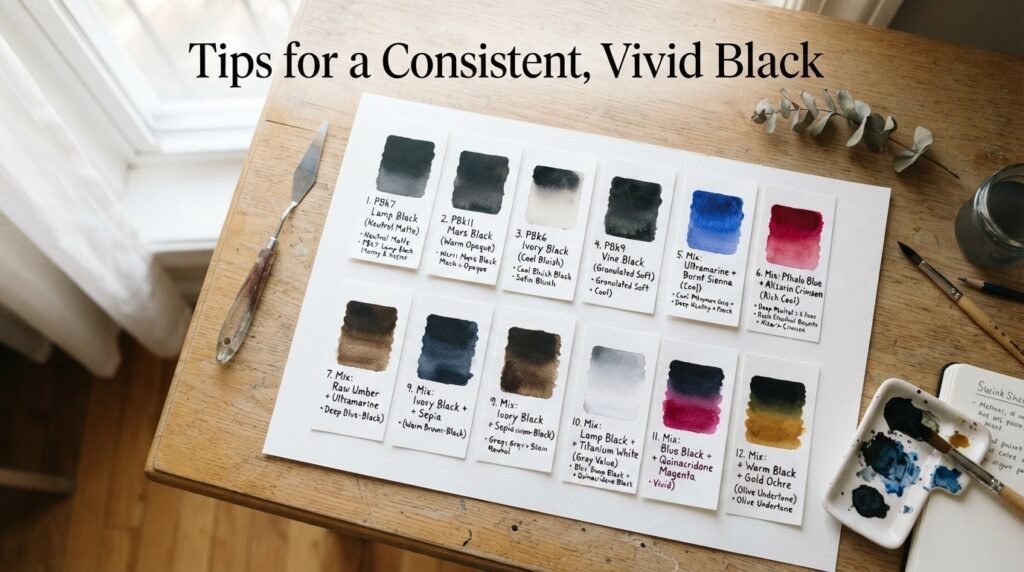
- Use quality, concentrated pigments. Cheap or heavily diluted paints struggle to reach true darkness and often stall out at dark gray.
- Mix in small test batches first. Dried paint often looks different from wet paint, so test a small amount before committing to a full batch.
- Keep a ratio log. Once you land on a black you like, write down the exact proportions so you can recreate it exactly for future projects.
- Dry-test on your actual surface. Black can look warmer or cooler depending on the material underneath it, so always test on the same surface you’ll be using for the final piece.
Following these habits makes how do you make black color far more predictable, which matters most if you’re matching an existing black across multiple canvases or a large mural.
Real-Life Uses of Black

Black shows up constantly across nearly every industry.
In fashion, black remains the single most versatile wardrobe color, used for everything from formalwear to everyday basics because it pairs with virtually any other color.
In interior design, black is often used sparingly as an accent — window frames, light fixtures, or a single statement wall — to add contrast and definition without overwhelming a space.
Shades and Variations of Black
Black isn’t always a single flat tone — several named variations carry slightly different undertones and uses.
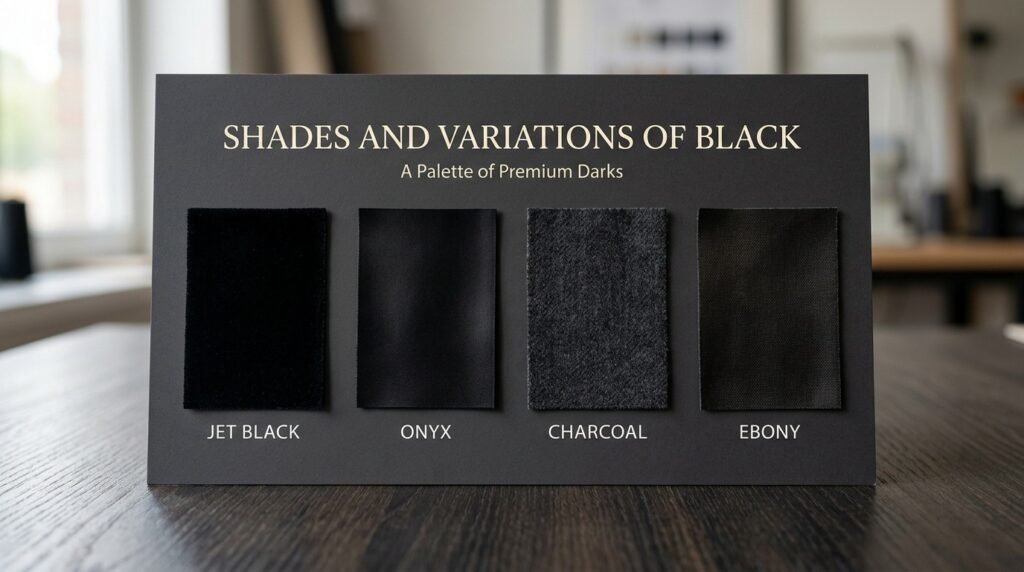
| Shade Name | Hex Code | Best Used For |
| Jet Black | #0A0A0A | Fashion, formalwear, high-contrast design |
| Onyx | #0F0F0F | Jewelry, branding, elegant packaging |
| Charcoal | #2B2B2B | Interior walls, furniture, softer contrast |
| Ebony | #150E0A | Wood finishes, warm-toned decor |
Jet black and onyx both lean toward a true, neutral darkness suited to bold fashion or branding choices, while charcoal and ebony carry slightly warmer or softer undertones that work better in interiors where a harsh, pure black might feel too stark.
Where Black Sits on the Color Wheel
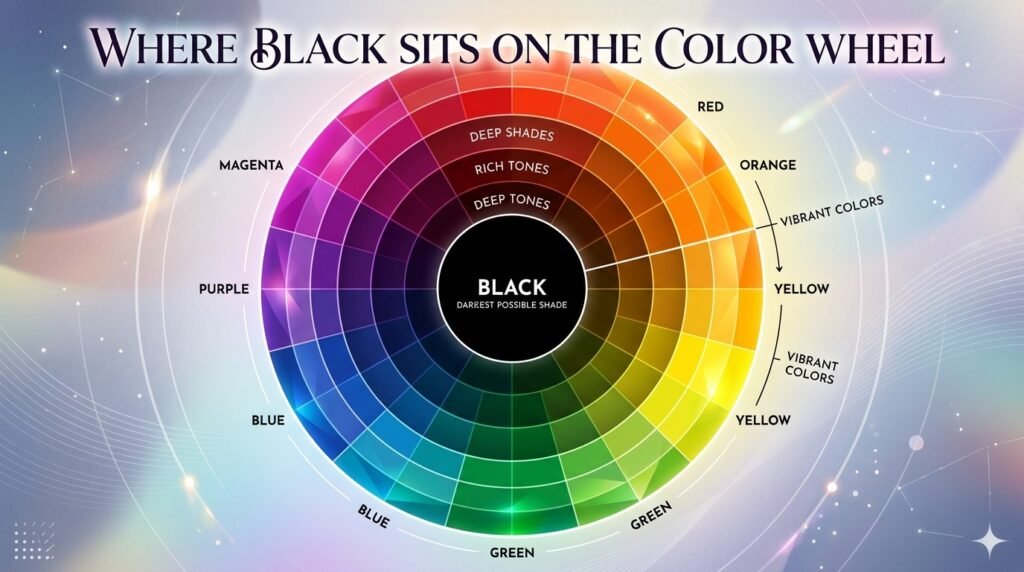
Black doesn’t sit on the outer ring of the traditional color wheel at all — instead, it sits conceptually at the center, representing the darkest possible value any hue can reach. Because of this, black doesn’t have a true complementary color the way red and green do; instead, it pairs with every hue on the wheel, deepening and grounding whatever color sits next to it. Black is generally classified as a shade rather than a true hue, created by adding darkness to any color until saturation and light are both minimized. Analogous “colors” near black include charcoal, deep navy, and dark brown, all of which share black’s low-light, high-density character while still retaining a faint trace of hue.
Conclusion
At its core, how to make black comes down to combining red, blue, and yellow in roughly equal, concentrated parts, or mixing a complementary pair like blue and orange until the saturation cancels itself out. From there, small ratio adjustments help you avoid the two most common pitfalls — ending up with brown instead of black, or navy instead of black. The best way to get comfortable with what colors make black is to test small batches, keep blue as your dominant color, and adjust gradually until the mix reads as a true, neutral black.
FAQs About Making Black
What colors make black paint?
Black paint is made by mixing red, blue, and yellow together in roughly equal, concentrated parts, or by combining complementary colors like blue and orange until their saturation cancels out.
How do you make black color darker?
To deepen a near-black mix, add a small amount more of blue rather than adding all three primaries again, since blue reinforces darkness without pulling the mix toward brown.
Can you make black without blue?
It’s difficult to get a true black without blue, since blue is what neutralizes the natural warmth of red and yellow; without it, most mixes settle into dark brown instead.
Why does my black paint look brown instead of black?
This usually means red or yellow is overpowering the mix; adding more blue gradually will pull the tone back toward a neutral black.
Is black a warm or cool color?
Black is technically neutral, but it can lean warm (brownish-black) or cool (blue-black) depending on which color dominates the mix.
What is the hex code for black?
The standard hex code for black is #000000, corresponding to RGB values of 0, 0, 0, meaning zero light output across all three channels.
Can primary colors actually create a true, pure black?
Not quite — mixing red, blue, and yellow by hand typically produces a very dark, near-black tone rather than a perfectly pure black, since pigments always retain a slight trace of hue even at full concentration.