What Color Do Red, Green, and Blue Make? The Complete Mixing Guide
Ever wondered what color do red, green, and blue make when you combine all three at once? It’s one of the most fascinating questions in color theory — because the answer completely flips depending on whether you’re mixing paint or light.
Main takeaway: In paint, mixing red, green, and blue together produces a dark, muddy brown or near-black. In light, combining red, green, and blue produces white. Same three colors, two opposite results.
This trio sits right at the heart of color theory’s biggest twist: paint and light don’t play by the same rules. So let’s dig into it properly — what color do red, green, and blue make, why the answer splits in two directions, and how you can predict exactly what you’ll get depending on your medium.
Understanding Red, Green, and Blue as Colors
Before mixing, it helps to know what each of these three colors brings to the table.
Red is a primary color in the RYB (red-yellow-blue) paint model — warm, energetic, and impossible to create by mixing other paint colors.
Green is a secondary color in the RYB model, made by mixing blue and yellow — cool-to-neutral, tied to nature and calm.
Blue is also a primary color in the RYB model — cool, calming, and like red, a starting point rather than something mixed from other paint colors.
Here’s why this trio matters so much: in light, red, green, and blue aren’t the RYB set at all — they’re the three primary colors of the RGB (additive) model, the actual building blocks of every color your screen displays. That’s a completely different system from the paint world, and it’s the reason this particular combination reveals so much about how color mixing really works.
Think of paint and light like two different recipes using similarly named ingredients — “red” in a paint tube and “red” on a screen behave in almost opposite ways once you start combining them.
Beginner Tip: If you’re experimenting with paint, add these three colors in small, equal increments rather than dumping in a full color at once — with three primaries combined, it’s very easy to rocket straight past a rich brown into unworkable black mud.
What Color Do You Get When You Mix Red, Green, and Blue Paint?
Here’s the central question for painters: red, green, and blue make what color when mixed, exactly, and how does the ratio shift things? Here are three common combinations:
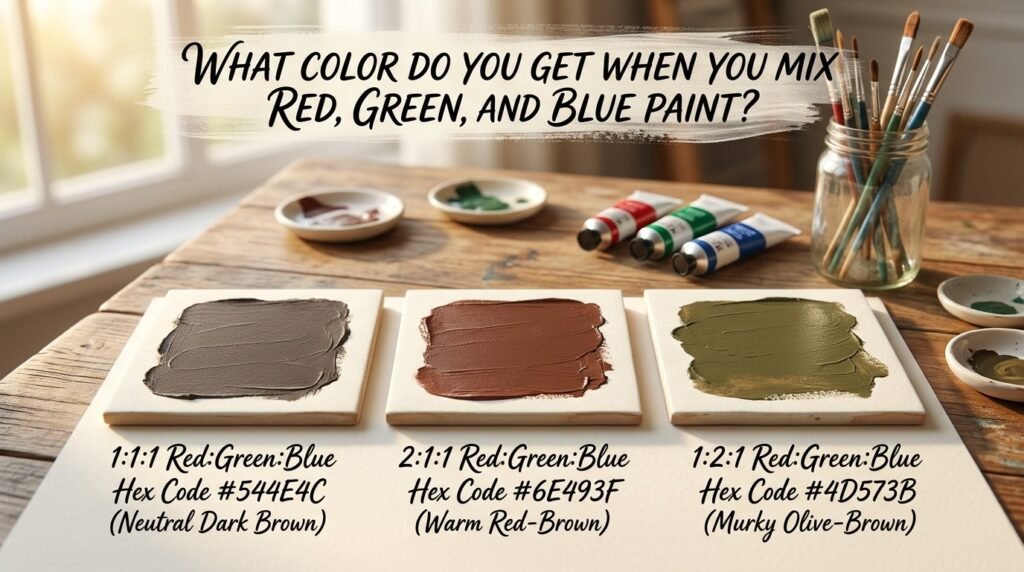
1:1:1 Ratio (equal parts red, green, and blue)
- Result: A dark, neutral brown-gray, close to near-black
- Hex code: #3b3a36
- Use case: Useful for deep shadow tones or a neutral dark base in underpainting
2:1:1 Ratio (double red, one part green, one part blue)
- Result: A warm, reddish-brown
- Hex code: #5c3a2e
- Use case: Good for earthy shadow tones, tree bark, or aged wood
1:2:1 Ratio (one part red, double green, one part blue)
- Result: A murky, olive-leaning brown
- Hex code: #3f4530
- Use case: Works well for swampy water, mossy undergrowth, or camouflage tones
Full Mixing Chart: Red + Green + Blue Pigment Combinations
Different pigment brands and ratios will shift your outcome. Here’s a mixing chart to reference:
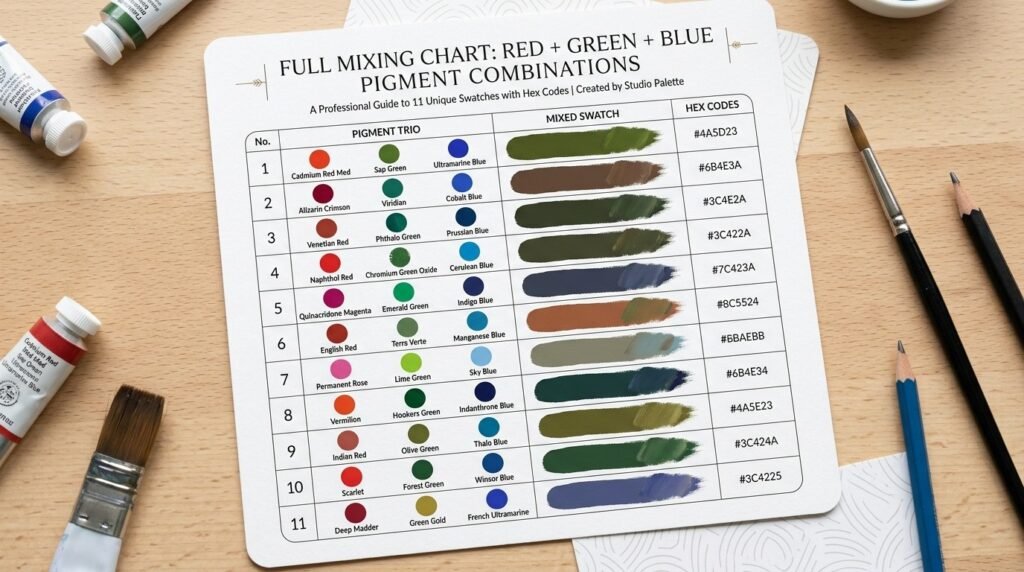
| Red Shade | Green Shade | Blue Shade | Resulting Color | Hex Code |
| Cadmium Red | Phthalo Green | Ultramarine Blue | Dark Neutral Brown | #3a352f |
| Alizarin Crimson | Sap Green | Prussian Blue | Deep Olive-Brown | #3d3d2c |
| Naphthol Red | Viridian | Cobalt Blue | Muted Slate-Brown | #40403a |
| Pyrrole Red | Hooker’s Green | Cerulean Blue | Warm Gray-Brown | #453d33 |
| Vermilion | Emerald Green | Ultramarine Blue | Rich Umber | #4a3826 |
| Cadmium Red Light | Permanent Green Light | Phthalo Blue | Dark Khaki-Brown | #443f2a |
| Crimson | Chromium Oxide Green | Indigo | Deep Charcoal-Brown | #332f2b |
| Scarlet | Forest Green | Cobalt Blue | Warm Bark Brown | #4d3a2a |
| Fire Engine Red | Yellow-Green | Ultramarine Blue | Muddy Olive | #494733 |
| Venetian Red | Cadmium Green | Prussian Blue | Earthy Brown-Gray | #413a30 |
| Rose Madder | Emerald Green | Cerulean Blue | Deep Plum-Brown | #3e332f |
What Color Does Red, Green, and Blue Light Make?
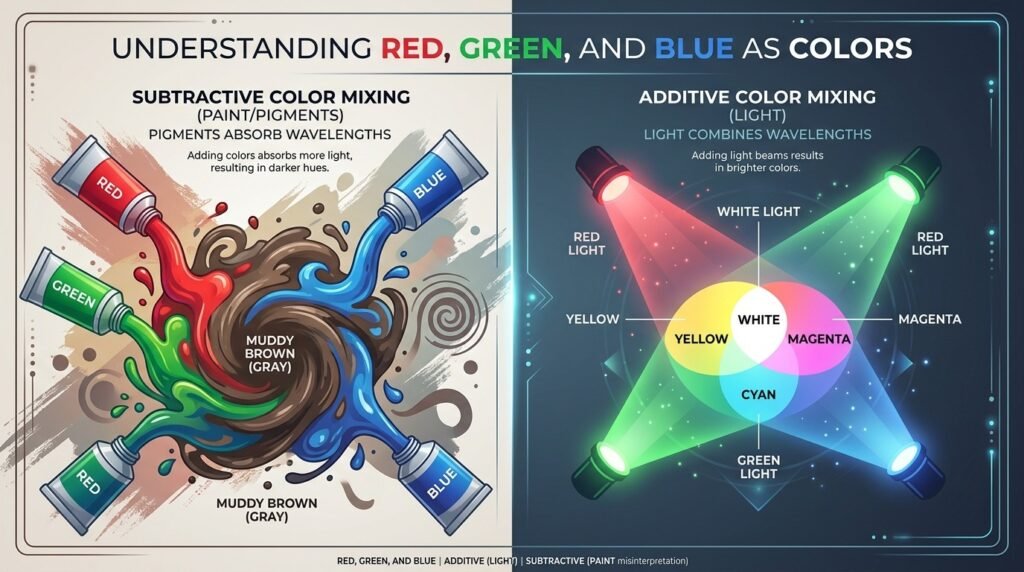
This is where the story flips entirely. Paint mixing is subtractive — pigments absorb certain wavelengths and reflect others, so combining colors removes light and produces darker results, which is exactly why red, green, and blue paint end up as a dark brown.
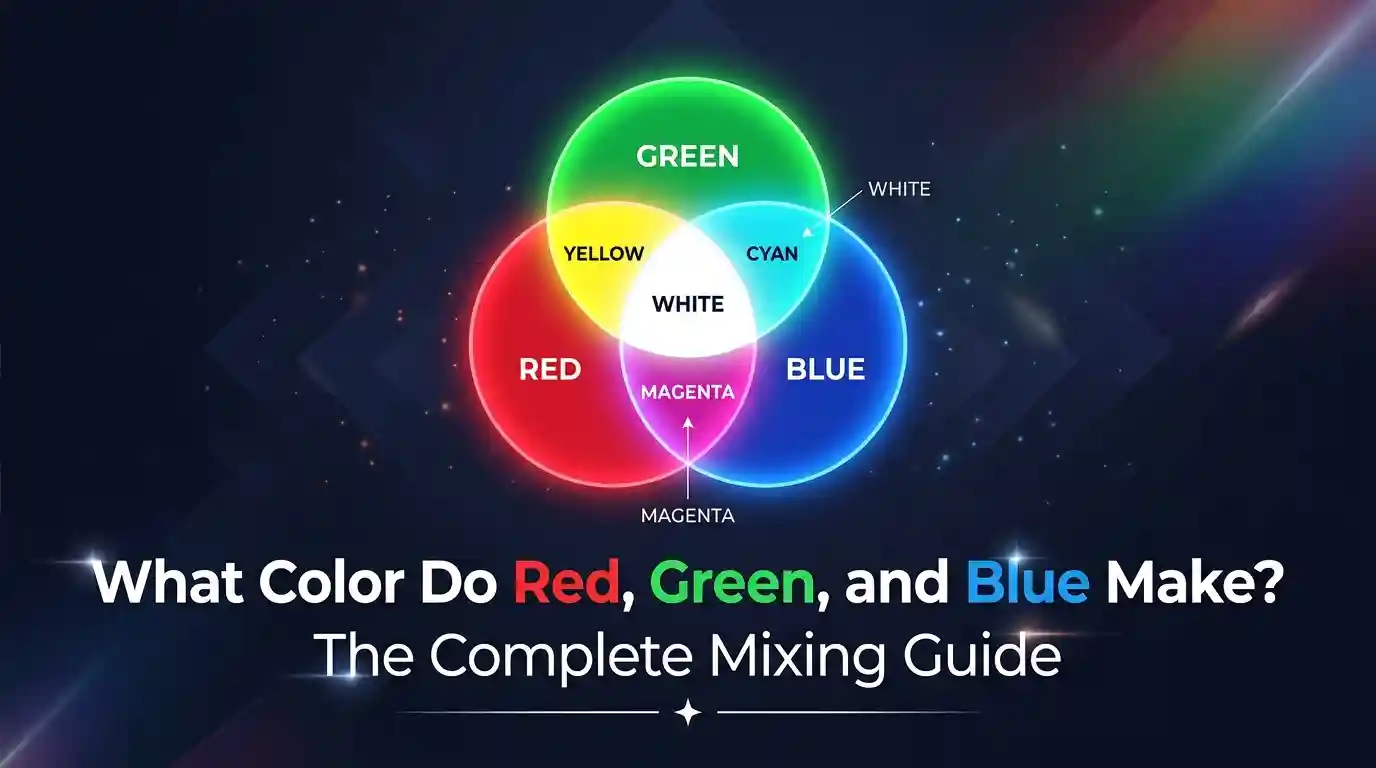
Light mixing, used in screens and stage lighting, is additive, based on the RGB (red-green-blue) model. Here, colors combine by adding wavelengths together, and mixtures get brighter rather than darker. Red, green, and blue are the three fundamental primaries of this system — and when combined at full, equal intensity, what color does red, green, and blue light make has a clean, well-known answer: white.
This is literally how every screen you look at works: each pixel is made of tiny red, green, and blue sub-pixels, and turning all three on at full brightness produces white light.
Use cases where this matters:
- Screens and monitors, where every color you see is built from varying intensities of red, green, and blue sub-pixels
- Stage and theatrical lighting, where overlapping red, green, and blue spotlights at equal intensity create a white wash on stage
- LED displays and signage, where RGB LEDs are combined to produce the full visible spectrum, including white
Subtractive vs. Additive Mixing: Side-by-Side Comparison
| Feature | Subtractive (Paint) | Additive (Light) |
| Base model | RYB / CMYK | RGB |
| Mixing effect | Colors get darker | Colors get brighter |
| Red + Green + Blue result | Dark brown / near-black | White |
| Primaries | Red, yellow, blue | Red, green, blue |
| Common in | Painting, printing | Screens, stage lighting, LEDs |
How Ratio Affects the Final Color
| Ratio (Red: Green: Blue) | Resulting Color (Paint) | Best Use Case |
| 1:1:1 | Dark neutral brown-gray | Shadow base, underpainting |
| 2:1:1 | Warm reddish-brown | Tree bark, aged wood |
| 1:2:1 | Murky olive-brown | Swamp water, moss |
| 1:1:2 | Cool slate-brown | Stormy shadows, wet stone |
| 3:1:1 | Deep, warm umber | Rich earth tones |
Why Your Mix Looks Muddy — and How to Fix It
Mixing three colors at once is much more prone to “mud” than mixing just two, so it’s worth knowing exactly why it happens:
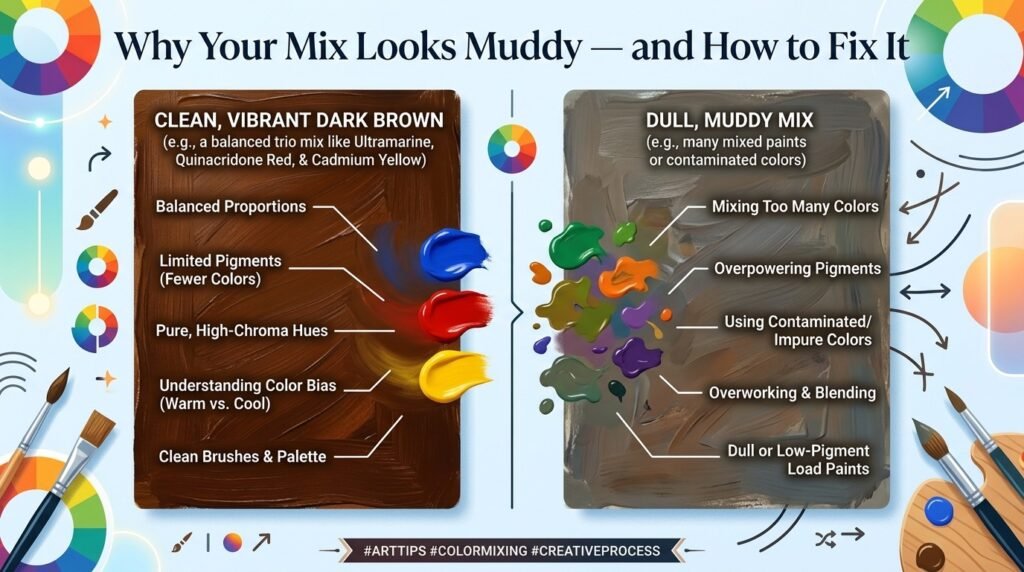
1. Too many competing undertones. With three separate pigments, each carrying its own subtle bias, the chances of clashing tones multiply fast. Fix: Choose pigments that share similar undertones (all warm or all cool) before combining all three.
2. Overmixing. Stirring three colors together for too long — or adding them in the wrong order — flattens vibrancy quickly. Fix: Mix two colors first, evaluate the result, then introduce the third gradually.
3. A dominant third pigment throwing off balance. Adding a strongly tinting color (like Phthalo Blue or Phthalo Green) even in a small amount can overpower the other two. Fix: Add strong-tinting pigments last, in very small increments.
4. Cheap or chalky paint. Lower-quality pigments often contain fillers that dull three-way mixes even faster than two-way ones. Fix: Use artist-grade paints, especially for pigments you’re combining in a trio.
“Mixing three colors at once is like adding three spices to a dish instead of two — it’s easy to end up with a flavor that’s just ‘brown’ instead of something distinct, unless you add them one at a time and taste as you go.”
Best Pigments to Mix for Clean Results
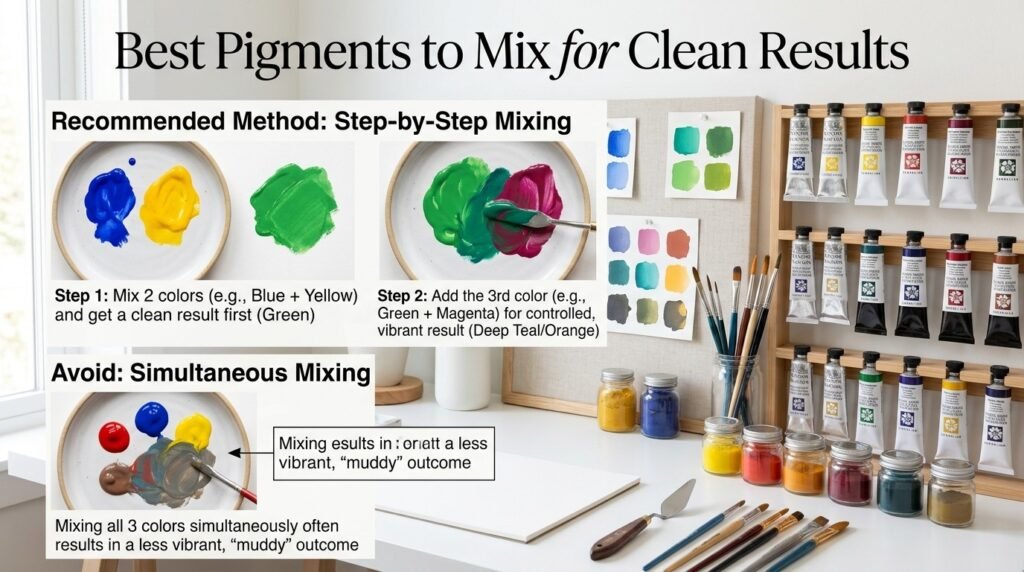
| Pigment Trio | Result | Notes |
| Cadmium Red + Phthalo Green + Ultramarine Blue | Clean, dark neutral brown | Great for beginners |
| Alizarin Crimson + Sap Green + Prussian Blue | Deep olive-brown | Good for landscape shadows |
| Vermilion + Emerald Green + Ultramarine Blue | Rich umber | Strong for underpainting |
| Pyrrole Red + Hooker’s Green + Cerulean Blue | Warm gray-brown | Balanced, versatile mix |
| Scarlet + Forest Green + Cobalt Blue | Warm bark brown | Ideal for tree and wood tones |
Mixing tip: Combine two colors first and get a clean result before introducing the third — this gives you far more control than mixing all three simultaneously.
Real-Life Examples of Red, Green, and Blue Mixed
This three-color relationship shows up constantly, in very different ways depending on the medium:
- Traditional art: Painters use red, green, and blue combined (usually two at a time, adjusted with a third) to create rich neutral browns and grays for shadows and underpainting.
- Interior design: Neutral brown-gray tones born from this kind of mix are popular for accent walls and furniture that need to feel grounded without reading as a “true” brown.
- Digital media: Every single color on your phone, TV, or monitor is built from red, green, and blue light values — this is the foundation of all digital color, from a plain white background to the most saturated graphic.
What Happens When You Add White, Black, or a Fourth Color?
Once you’ve mixed your base red-green-blue brown, modifiers let you adjust it further:
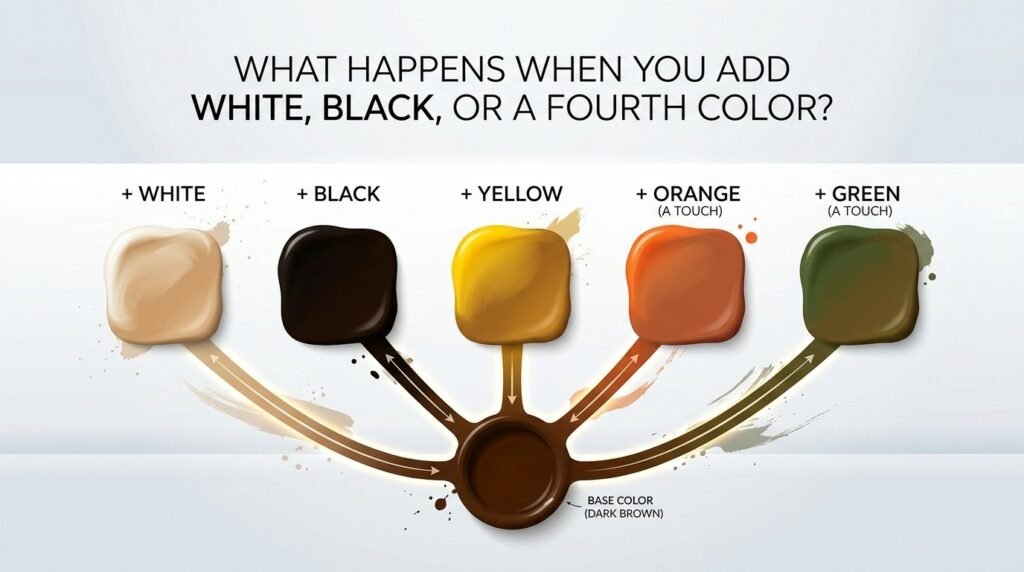
- Add white: Lightens the mix into a soft, grayish taupe. Example hex: #a8a29a
- Add black: Deepens it into a near-black, charcoal-brown. Example hex: #221f1c
- Add yellow: Warms the mix toward a more golden-brown. Example hex: #5c4a2a
- Add a fourth color (like a touch of orange): Pushes the mix toward a warmer, more rust-toned brown. Example hex: #5a3d28
Paint vs. Digital Media: A Concrete Comparison
If you’re painting traditionally, mixing Cadmium Red, Phthalo Green, and Ultramarine Blue gives you a clean dark brown around #3a352f. If you’re designing digitally and want the RGB version of this same trio, setting Red, Green, and Blue values all to their maximum (255, 255, 255) doesn’t give you brown at all — it gives you pure white, since additive mixing works in the opposite direction from paint.
This is the single most important distinction to understand about this color trio: physical paint requires understanding pigment absorption and subtractive mixing, while digital light works by adding wavelengths together toward white, not away from it toward brown.
Tips for Artists
- Mix two at a time, then adjust with the third: This gives you far more control than combining all three simultaneously.
- Match undertones where possible: Warm reds with warm greens and warm blues (and vice versa for cool) reduces the risk of mud.
- Test on your palette first: Always dab a small trio mix before applying it to your canvas.
- Layer instead of mixing flat: For richer depth, apply thin glazes of each color over a dried base rather than mixing all three fully together.
The Resulting Brown in Fashion and Interior Design
The neutral, grounded brown that comes from mixing red, green, and blue pigments has a natural home in both fashion and interiors. In fashion, deep neutral browns show up constantly in outerwear, accessories, and fall collections, valued for pairing easily with almost anything else in a wardrobe. In interior design, this kind of muted brown-gray is popular for furniture, flooring, and accent walls that need to feel warm and grounded without leaning into a “true,” saturated brown.
If you’re pulling a tone like this into a home project, it’s worth testing a few painted swatches against your existing furniture and lighting — a color-matching or paint-sample app can save a lot of guesswork before you commit to a full room.
Where This Result Sits on the Color Wheel
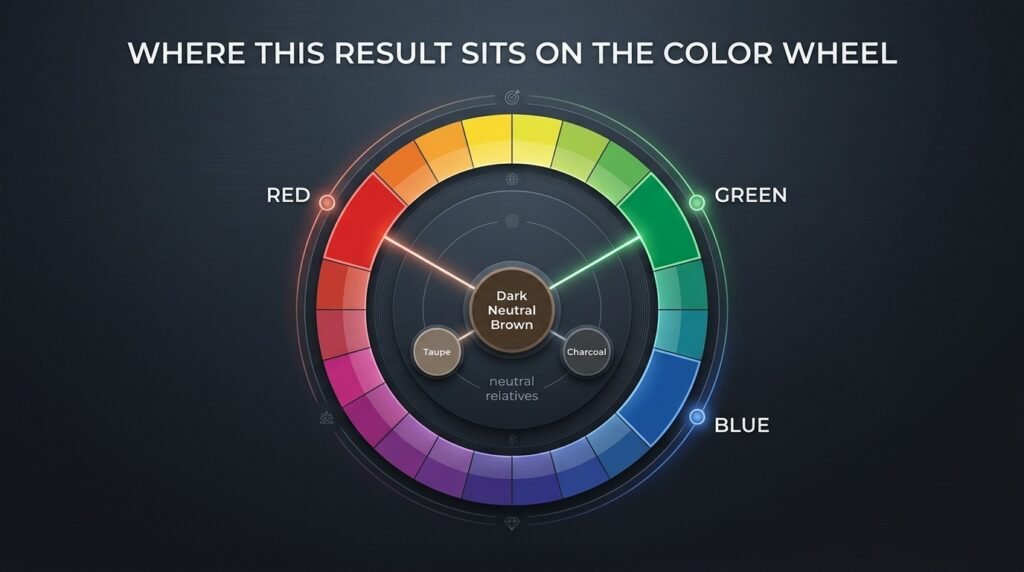
The dark brown produced by mixing red, green, and blue paint sits as a neutral, tertiary-adjacent tone — since it draws from all three primaries (in the RYB sense, red and blue directly, green indirectly through yellow and blue), it doesn’t have a fixed spot on the wheel the way a single hue does. Its closest analogous neutrals are charcoal, taupe, and warm gray, and pairing it with any single saturated hue (like a deep teal or mustard) creates strong, grounded contrast in a palette.
Conclusion
To sum it up: the answer to what color do red, green, and blue make depends entirely on your medium. In paint, this trio makes a dark, muddy brown or near-black neutral. In light, the very same three colors combine to make pure white — the complete opposite result, from the same three names.
Watch out for muddy results in paint by mixing two colors first and adjusting with the third gradually, rather than combining all three at once. Whether you’re mixing a neutral shadow tone on canvas or just curious why your TV screen looks the way it does, you now have a complete answer to what color do red, green, and blue make — in both paint and light.
FAQs
What color do red, green, and blue make when mixed? In paint, red, green, and blue combine into a dark, muddy brown or near-black neutral. In light, the same three colors combine into pure white.
Why does red, green, and blue light make white, but the paint version makes brown? Paint mixing is subtractive, removing light and darkening as you combine colors, while light mixing is additive, combining wavelengths to brighten toward white — the same three names but opposite systems.
What color does red, green, and blue make on a screen?
On a screen, red, green, and blue are the RGB primaries, and combining all three at full intensity produces white, since every screen pixel is built from these three lights.
Is the brown that red, green, and blue paint make a primary, secondary, or tertiary color?
It’s best described as a neutral rather than a wheel color — it results from combining all three paint primaries (directly or indirectly) rather than sitting at a fixed point on the color wheel.
Why does my red, green, and blue paint mix look muddy or gray instead of a clean brown?
This usually happens from clashing undertones between the three pigments, overmixing, or adding a strong-tinting color too early in large amounts.
What’s the best pigment trio if I want a clean answer to what color do red, green, and blue make?
Cadmium Red, Phthalo Green, and Ultramarine Blue mixed carefully (two at a time, then adjusted) reliably produce a clean, dark neutral brown.
Can I lighten the red-green-blue paint mix without losing the neutral tone?
Yes — add small amounts of white gradually. This creates a soft taupe rather than pushing the mix toward gray or losing its warmth entirely.