How Many Colors Are in the Rainbow? The Truth About Rainbow Colors
Almost everyone learns the same answer in school: red, orange, yellow, green, blue, indigo, violet. Seven colors, neatly lined up, are easy to remember with the acronym ROYGBIV. But how many colors are in the rainbow, really? The answer turns out to be far more interesting than a simple number.
This article breaks down the science of how rainbows form, why the number seven became the standard answer, and what modern color science actually tells us. By the end, you’ll understand why this seemingly simple question has such a surprisingly complex answer.
If you’ve ever paused mid-sentence while explaining rainbow colors to a child, wondering whether indigo really counts, you’re not alone. Even scientists don’t fully agree, and that disagreement is part of what makes this topic so fascinating.
The Short Answer
Officially, a rainbow is described as having 7 colors: red, orange, yellow, green, blue, indigo, and violet. This is the answer most people learn, and it’s the one you’ll find in textbooks around the world.

However, in reality, a rainbow contains a continuous spectrum of light, with countless shades blending seamlessly into one another. The number seven is a human-made categorization, not a strict scientific boundary. Understanding how many colors are in the rainbow really depends on whether you’re asking about tradition or physics.
The Science Behind Rainbows
To fully understand the color count, it helps to know how rainbows actually form.
How Rainbows Form
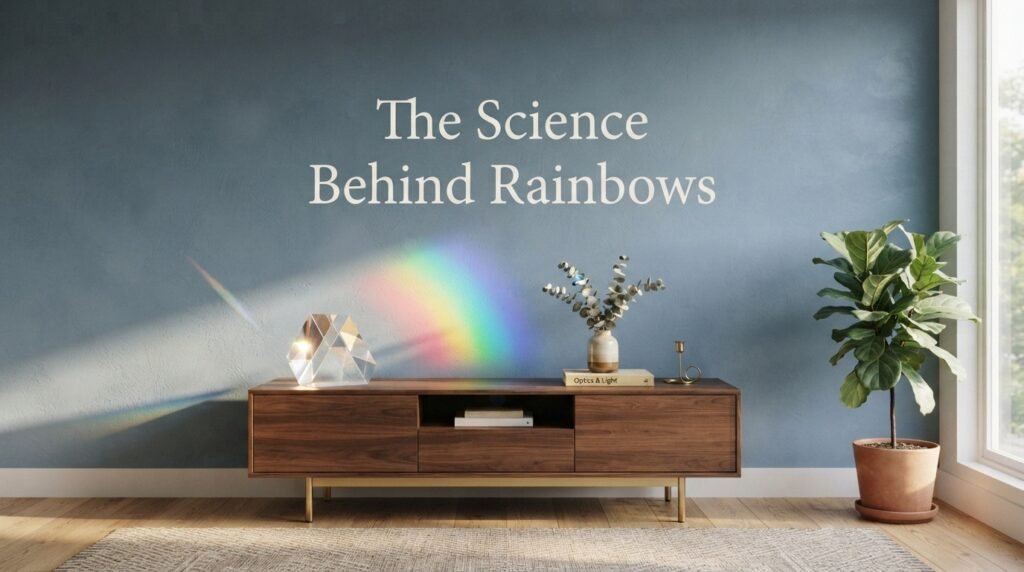
Rainbows appear when sunlight passes through raindrops in the air. As light enters a raindrop, it bends, or refracts. It then reflects off the inside of the droplet and bends again as it exits. This bending separates white light into its different wavelengths, creating the familiar arc of color we see in the sky.
What Is Light Actually Made Of?
Sunlight looks white, but it’s actually made up of many different wavelengths of visible light. Each wavelength corresponds to a different color, ranging roughly from 380 to 700 nanometers. Shorter wavelengths appear as violet and blue, while longer wavelengths appear as orange and red.
Why We See a Spectrum, Not Bands
Because wavelengths shift gradually rather than jumping suddenly, a rainbow doesn’t actually have sharp lines between colors. What we perceive as distinct bands is really our brain grouping a smooth gradient into recognizable categories. This is a key reason why the question of how many colors are in the rainbow doesn’t have one single, scientifically fixed answer.
Why Do We Say There Are 7 Colors?
If rainbows are a continuous spectrum, why does everyone learn the number seven? The answer traces back to one very influential scientist.
Isaac Newton’s Role
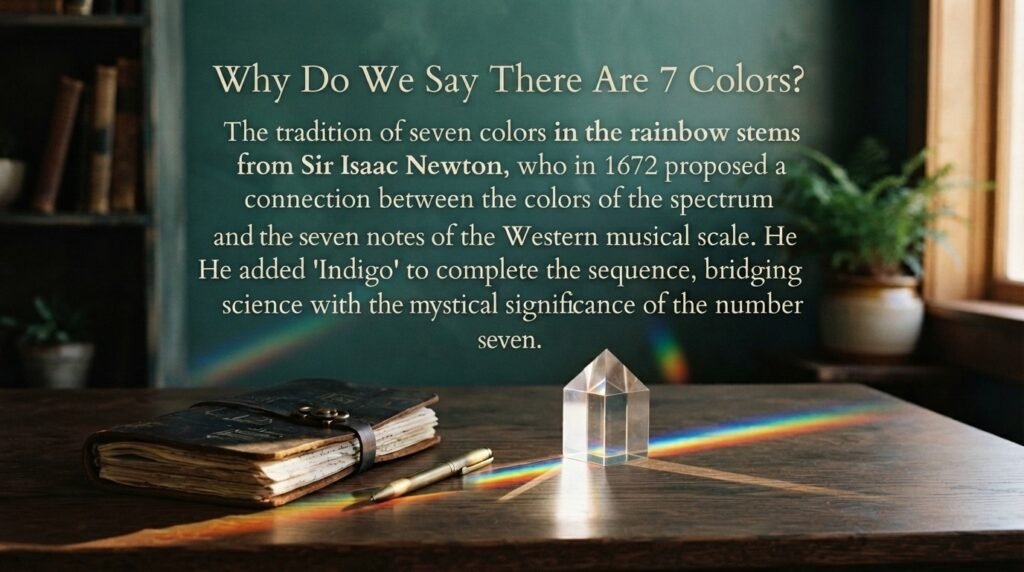
In the 17th century, Isaac Newton was the first to systematically study how a prism splits white light into colors. Originally, he identified only five colors. Later, he expanded the list to seven, adding orange and indigo.
Newton’s decision wasn’t purely based on what the eye could distinguish. He was influenced by the idea that seven was a meaningful number, tying it to the seven notes of a musical scale. At the time, numbers like seven held cultural and even mystical significance, which shaped his final classification.
This historical decision is the main reason the number seven stuck, and it’s why the answer to how many colors are in the rainbow has stayed consistent in textbooks for centuries, even though the science behind it is more nuanced.
The 7 Colors of the Rainbow (ROYGBIV) Explained
Here’s a quick breakdown of each traditional color and its approximate wavelength range.
- Red (620-700 nm): The longest visible wavelength, appearing on the outer edge of the rainbow.
- Orange (590-620 nm): A warm blend sitting between red and yellow.
- Yellow (570-590 nm): One of the brightest and most easily visible bands.
- Green (495-570 nm): Often the widest visible band in a rainbow.
- Blue (450-495 nm): A cool tone transitioning toward violet.
- Indigo (420-450 nm): A deep blue-purple, historically included by Newton.
- Violet (380-420 nm): The shortest visible wavelength, on the inner edge of the arc.
Is Indigo Really a Separate Color?
This is one of the most debated points in color science. Many modern researchers argue that indigo isn’t distinct enough from blue and violet for most human eyes to reliably separate it as its own band. Some scientists believe Newton included it mainly to reach the symbolic number seven, rather than because it was a clearly distinguishable color.
Do Different Cultures See Different Numbers of Colors?
Interestingly, not every culture agrees on seven. Language plays a surprisingly large role in how people categorize rainbow colors.
In some languages, there isn’t a separate word for blue and green, leading speakers to describe the rainbow with fewer bands. In other cultures, rainbows are traditionally described with five or six colors instead of seven. This suggests that the number isn’t a fixed law of nature, but partly a product of language and cultural tradition.
This cross-cultural difference reinforces the idea that how many colors are in the rainbow is, at least partly, a question of perception and language rather than pure physics.
Rainbow Colors in Nature vs Science
From a strictly physical standpoint, a rainbow contains an essentially infinite number of colors. Wavelengths shift so gradually that there are no true dividing lines between them.
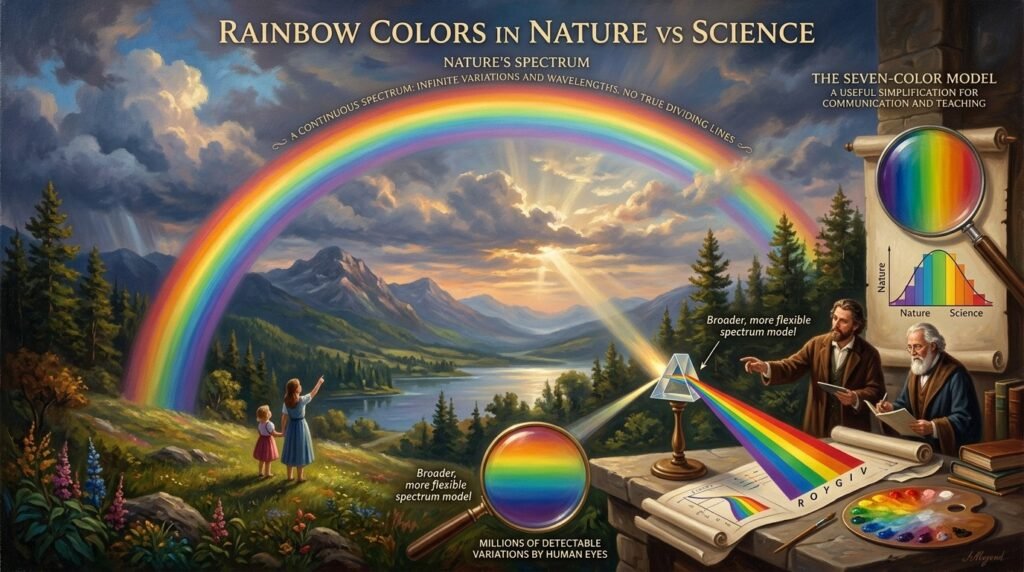
The seven-color model is a helpful simplification for teaching and communication, but it doesn’t reflect the literal physics of light.
In truth, human eyes can distinguish millions of color variations, though only a fraction of those appear distinctly within a rainbow’s visible band. This is why some scientists and educators now describe rainbows using a broader, more flexible spectrum model instead of strict color bands.
How the Human Eye Perceives Rainbow Colors
Part of the reason how many colors are in the rainbow is such a tricky question comes down to human biology, not just physics.
Cone Cells and Color Detection
The human eye detects color using three types of cone cells, each sensitive to a different range of wavelengths — roughly corresponding to red, green, and blue light. Every color we perceive, including every shade in a rainbow, comes from these three cone types working together and sending signals to the brain.
Why Some People See Rainbows Differently
Not everyone perceives color the same way. People with color vision deficiencies may struggle to distinguish certain bands, such as red and green, within a rainbow. On the other end of the spectrum, a small number of people, mostly women, have a rare genetic condition called tetrachromacy, which may allow them to perceive even more color variation than the average person. This means the true answer to how many colors appear in a rainbow can vary slightly from person to person, based purely on biology.
Fun Facts About Rainbows
Beyond the debate over how many colors are in the rainbow, these natural light shows have plenty of other surprises.

- Double rainbows occur when light reflects twice inside water droplets, creating a fainter second arc with reversed colors.
- Moonbows are rare rainbows created by moonlight instead of sunlight, usually appearing much dimmer.
- No two people see the exact same rainbow. Because a rainbow depends on the angle between your eyes, the sun, and the raindrops, each viewer technically sees a slightly different arc.
- Rainbows are actually full circles. From an airplane, it’s sometimes possible to see a complete circular rainbow, since the ground normally blocks the lower half.
Frequently Asked Questions
Why are there 7 colors in a rainbow?
The number seven comes from Isaac Newton, who expanded his original five-color model to seven, partly influenced by the idea that seven held special cultural and musical significance.
Is indigo a real color?
Indigo is a recognized color, but many scientists debate whether it’s truly distinct enough from blue and violet to be its own separate band in a rainbow.
Do all rainbows have the same colors?
Yes, all rainbows follow the same order of colors based on wavelength, from red on the outer edge to violet on the inner edge, though visibility can vary based on atmospheric conditions.
Can rainbows have more than 7 colors?
Scientifically, yes. A rainbow is a continuous spectrum with countless shades, but the number seven remains the traditional, commonly taught classification.
What causes the colors in a rainbow to appear in a specific order?
Each wavelength of light bends at a slightly different angle inside a raindrop. Longer wavelengths, like red, bend less, while shorter wavelengths, like violet, bend more, resulting in the consistent color order we see.
Did ancient civilizations agree on how many colors are in the rainbow?
No. Historical records show that different ancient cultures described rainbows using anywhere from three to six colors, long before Newton’s seven-color model became widely accepted.
Final Thoughts
So, how many colors are in the rainbow? The traditional answer is seven, thanks largely to Isaac Newton’s influence centuries ago. But science tells a more nuanced story: a rainbow is actually a smooth, continuous spectrum containing far more shades than any single number could capture.
The next time you see a rainbow, take a closer look. You might notice that the transitions between colors are softer and more gradual than the neat seven-color version we all learned as children.