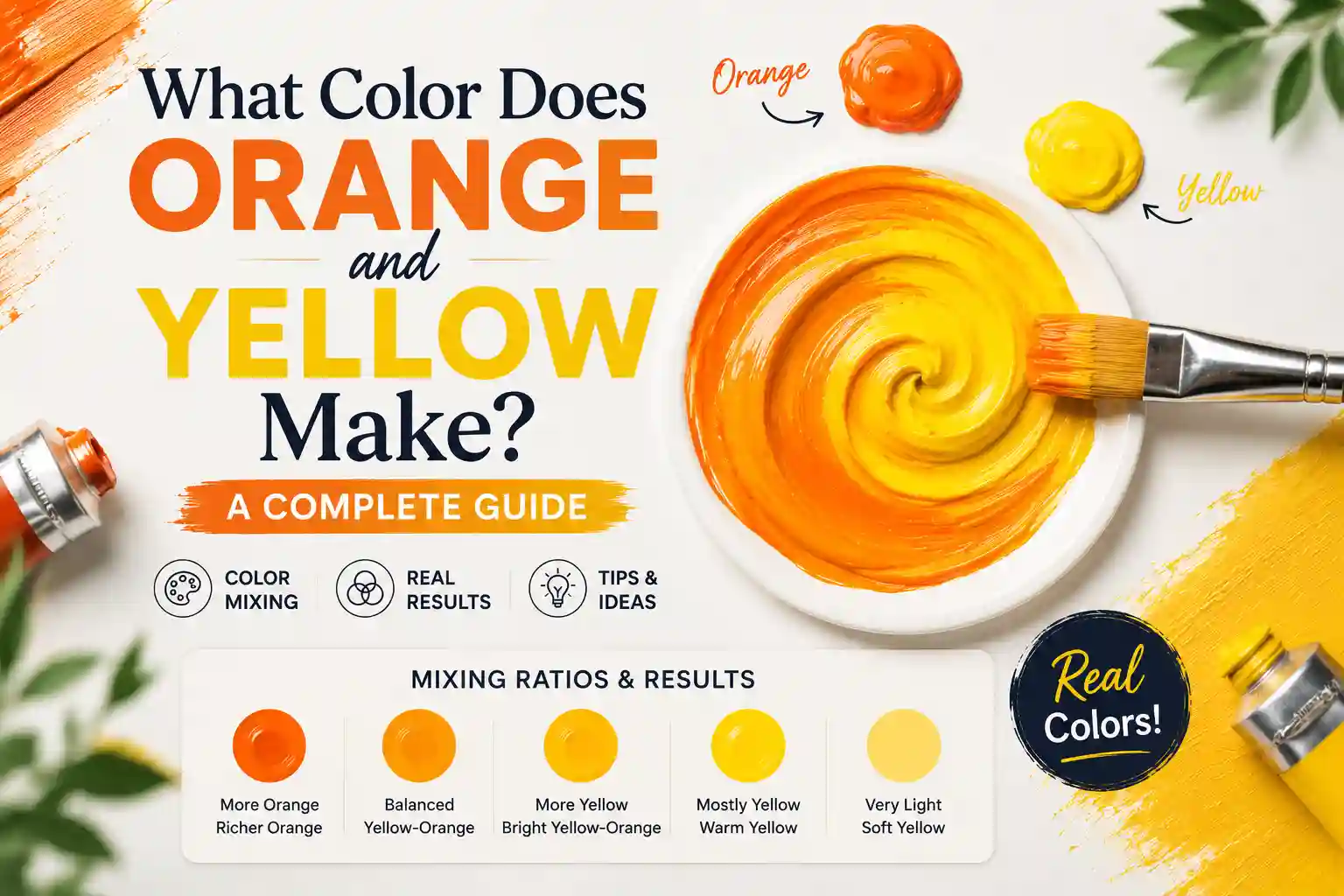
What Color Does Orange and Yellow Make? A Complete Guide
So, what color does orange and yellow make? The short answer is simple. Orange and yellow make yellow-orange, often called amber or marigold. That’s it. But the exact shade depends on a lot of small details.
Main Takeaway: Mixing orange and yellow paint creates a warm, glowing yellow-orange. The exact tone shifts between soft marigold, golden amber, and deep sunset-orange depending on the ratio you use.
This guide breaks down every part of that answer. You’ll learn the paint mix, the light mix, the ratios, the hex codes, and the common mistakes that dull a clean yellow-orange. Let’s dive in.
Understanding Orange and Yellow as Colors
Before we answer what color orange and yellow make when mixed, it helps to know what these two colors actually are.
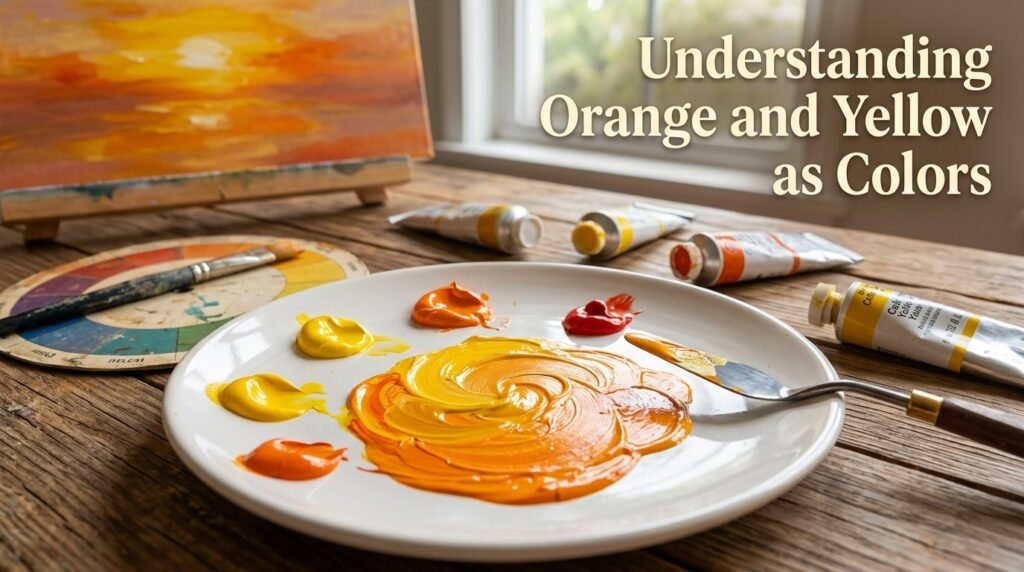
Yellow is a primary color. It can’t be created by mixing other colors. It’s a starting point. Orange, on the other hand, is a secondary color, made by mixing red and yellow. Because orange already contains yellow, this pairing behaves differently than mixing two unrelated colors.
Orange carries boldness and warmth. It feels energetic and confident. Yellow carries brightness and cheer. It feels sunny and light. When you combine them, you get a color that feels even more radiant and glowing than either one alone. That new color is yellow-orange.
This pairing matters because it sits close together on the color wheel. Colors that sit near each other, called analogous colors, blend smoothly and stay vibrant instead of turning muddy.
“Think of orange and yellow like a candle flame meeting sunlight,” one art teacher once said. “Blend them, and you get the exact glow of a warm afternoon.”
What Color Do You Get When You Mix Orange and Yellow Paint?
Here’s where things get practical. What color do orange and yellow make in real paint, not just in theory? Let’s look at three simple ratios.
1:1 Ratio (Equal Parts): Mix one part orange with one part yellow. You get a balanced marigold. This is the classic “golden glow” shade you see on a basic color wheel.
- Hex code: #FFB300
- Use case: General art projects, sunflower illustrations, kids’ craft mixing
2:1 Ratio (More Orange): Add two parts orange to one part yellow. The mix leans deeper. You get a warm amber, closer to a true sunset orange.
- Hex code: #FF9800
- Use case: Autumn scenes, warm lighting effects, cozy interior accents
1:2 Ratio (More Yellow): Add two parts yellow to one part orange. The mix leans brighter. You get a golden yellow-orange, close to a bright marigold-gold.
- Hex code: #FFCC33
- Use case: Cheerful branding, spring florals, sunny illustrations
Beginner Tip: Since orange already contains yellow, this mix rarely turns muddy. Start with your yellow base and add orange gradually. It’s much easier to deepen a mix than to brighten it back up.
Full Mixing Chart: Orange and Yellow Paint Combinations
If you want exact results, use this chart. It shows what happens when orange and yellow paint are mixed in different pigment combinations.
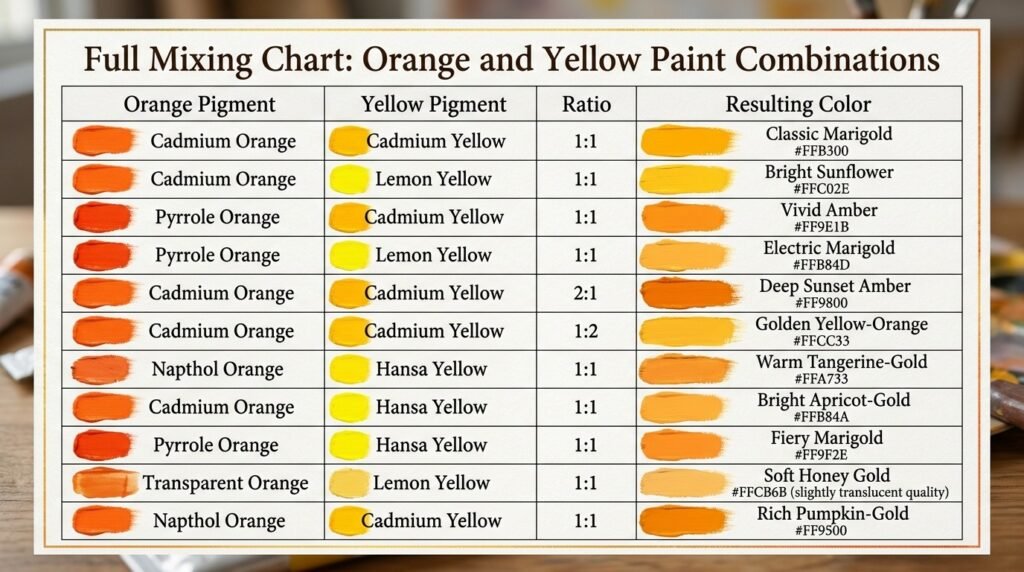
| Orange Pigment | Yellow Pigment | Ratio | Resulting Color | Hex Code |
| Cadmium Orange | Cadmium Yellow | 1:1 | Classic Marigold | #FFB300 |
| Cadmium Orange | Lemon Yellow | 1:1 | Bright Sunflower | #FFC02E |
| Pyrrole Orange | Cadmium Yellow | 1:1 | Vivid Amber | #FF9E1B |
| Pyrrole Orange | Lemon Yellow | 1:1 | Electric Marigold | #FFB84D |
| Cadmium Orange | Cadmium Yellow | 2:1 | Deep Sunset Amber | #FF9800 |
| Cadmium Orange | Cadmium Yellow | 1:2 | Golden Yellow-Orange | #FFCC33 |
| Napthol Orange | Hansa Yellow | 1:1 | Warm Tangerine-Gold | #FFA733 |
| Cadmium Orange | Hansa Yellow | 1:1 | Bright Apricot-Gold | #FFB84A |
| Pyrrole Orange | Hansa Yellow | 1:1 | Fiery Marigold | #FF9F2E |
| Transparent Orange | Lemon Yellow | 1:1 | Soft Honey Gold | #FFCB6B |
| Napthol Orange | Cadmium Yellow | 1:1 | Rich Pumpkin-Gold | #FF9500 |
Notice how the pigment brand changes the result. This is a key part of understanding what color orange and yellow make when mixed in real-world painting, not just in theory.
What Color Do Orange and Yellow Light Make?
Paint is not the only way to mix color. Light works differently. So, what color do orange and yellow light make?
This question uses additive color mixing, not subtractive mixing. Paint mixing removes light. Light mixing adds it. Interestingly, this is one case where paint and light land on a similar answer.
When you mix orange light and yellow light, you get a bright, glowing yellow-orange, close to the paint result but more luminous. Yellow light already contains red and green wavelengths, and orange light leans heavily red with some green, so the combined result stays warm and radiant.
- Hex code: #FFB84D
This is the RGB model at work. Screens, LEDs, and stage lights all rely on this system.
Where this shows up:
- Screens: TVs, phones, and monitors mix red, green, and blue light to create warm, glowing yellow-orange tones for icons and highlights
- LED lighting: Event designers often combine orange and yellow-amber LEDs for warm, sunset-style event lighting
- Theater and stage lighting: Lighting designers mix orange and yellow gels to create golden-hour effects on stage
“Mixing orange and yellow light is like doubling down on a sunset,” a lighting designer once explained. “The glow gets warmer and brighter, not muddier.”
Subtractive vs. Additive Mixing: A Side-by-Side Comparison
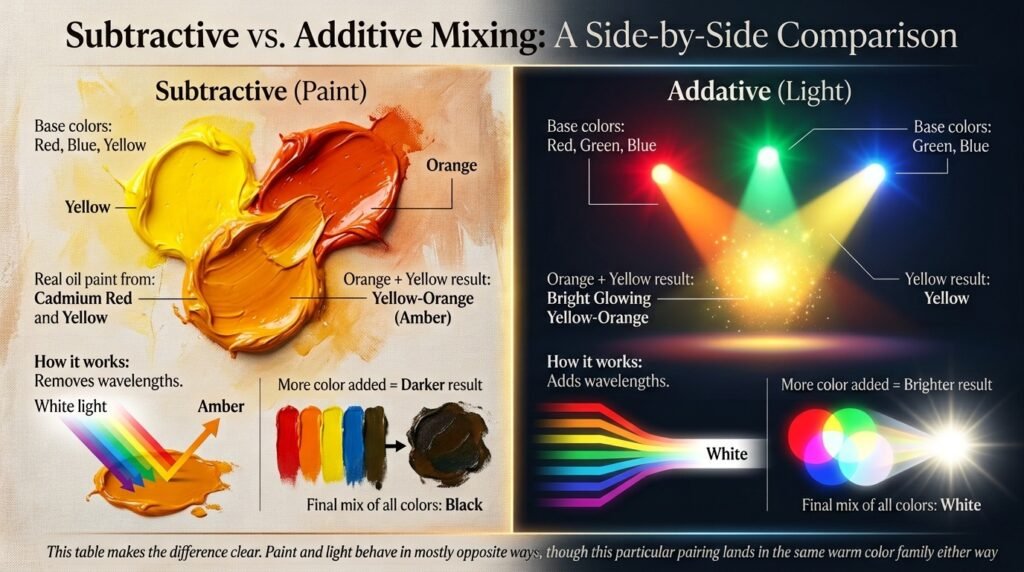
| Feature | Subtractive (Paint) | Additive (Light) |
| Base colors | Red, Blue, Yellow | Red, Green, Blue |
| Orange + Yellow result | Yellow-Orange (Amber) | Bright Glowing Yellow-Orange |
| How it works | Removes wavelengths | Adds wavelengths |
| Common use | Painting, printing | Screens, stage lighting |
| More color added = | Darker result | Brighter result |
| Final mix of all colors | Black | White |
This table makes the difference clear. Paint and light behave in mostly opposite ways, though this particular pairing lands in the same warm color family either way.
How Ratio Affects the Final Color
Ratio is everything. Small changes shift the mood of your yellow-orange completely.
| Ratio (Orange:Yellow) | Resulting Color | Use Case |
| 3:1 | Deep Sunset Amber | Autumn scenes, warm shadows |
| 2:1 | Warm Amber | Cozy interiors, golden-hour art |
| 1:1 | Classic Marigold | General purpose mixing |
| 1:2 | Golden Yellow-Orange | Cheerful branding, spring florals |
| 1:3 | Bright Sunflower Gold | Bold, energetic accents |
| Equal + extra pigment | Deep Burnt Marigold | Shadows, earthy sunset tones |
As you add more pigment overall, the mix gets deeper and richer. Push it too far, and you’ll edge toward a deep burnt marigold that feels heavier than bright. This happens because layering too much pigment reduces the amount of light your paint reflects.
Why Your Mix Looks Muddy or Flat — and How to Fix It
Sometimes your yellow-orange doesn’t look right. It looks dull, brownish, or flat instead of glowing. Here’s why.
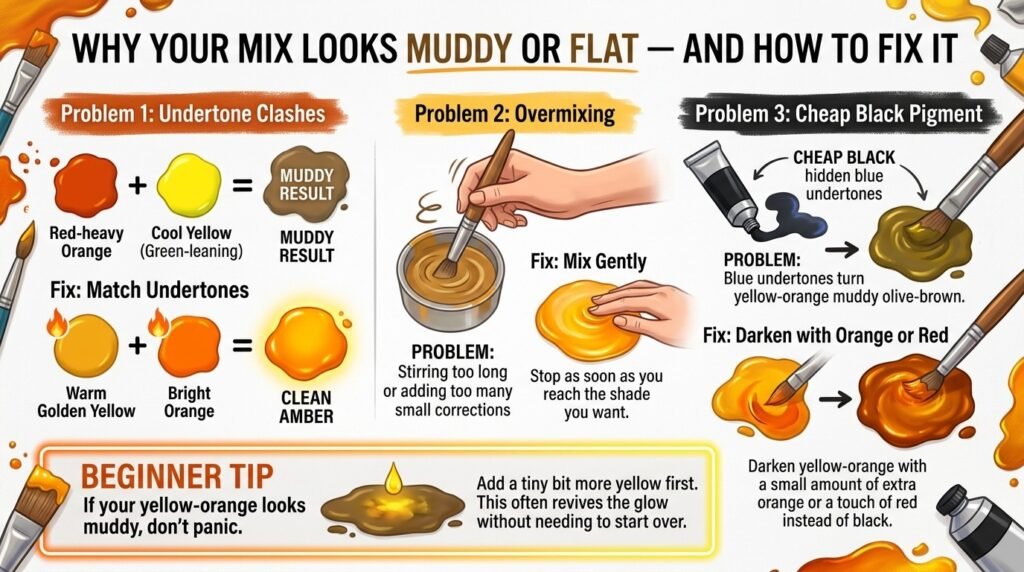
Problem 1: Undertone Clashes. Not all oranges and yellows are equal. Some oranges carry red-heavy undertones. Some yellows carry green-leaning undertones. Mixing a red-heavy orange with a cool yellow can create a muddier result. Fix: Match undertones. Use a warm, golden-leaning yellow with a bright orange for a cleaner amber.
Problem 2: Overmixing. Stirring too long or adding too many small corrections can dull your color. Fix: Mix gently. Stop as soon as you reach the shade you want.
Problem 3: Cheap Black Pigment. Some painters add black to darken this mix. Cheap black often contains blue undertones, which can turn yellow-orange into a muddy olive-brown. Fix: Darken yellow-orange with a small amount of extra orange or a touch of red instead of black.
Beginner Tip: If your yellow-orange looks muddy, don’t panic. Add a tiny bit more yellow first. This often revives the glow without needing to start over.
Best Pigments to Mix for Clean Results
| Orange Pigment | Yellow Pigment | Result Description |
| Pyrrole Orange | Hansa Yellow | Bright, clean electric marigold with high saturation |
| Cadmium Orange | Cadmium Yellow | Balanced, classic golden amber |
| Napthol Orange | Lemon Yellow | Warm, glowing tangerine-gold |
| Transparent Orange | Cadmium Yellow | Soft, luminous honey gold |
Mixing Tips:
- Test small amounts on a white palette before committing to a full batch
- Add orange slowly to control depth and warmth
- Use a palette knife instead of a brush for more even blending
- Keep a reference chart nearby so you don’t lose track of ratios
Real-Life Examples of This Color in Use
The yellow-oranges created from orange and yellow show up everywhere.
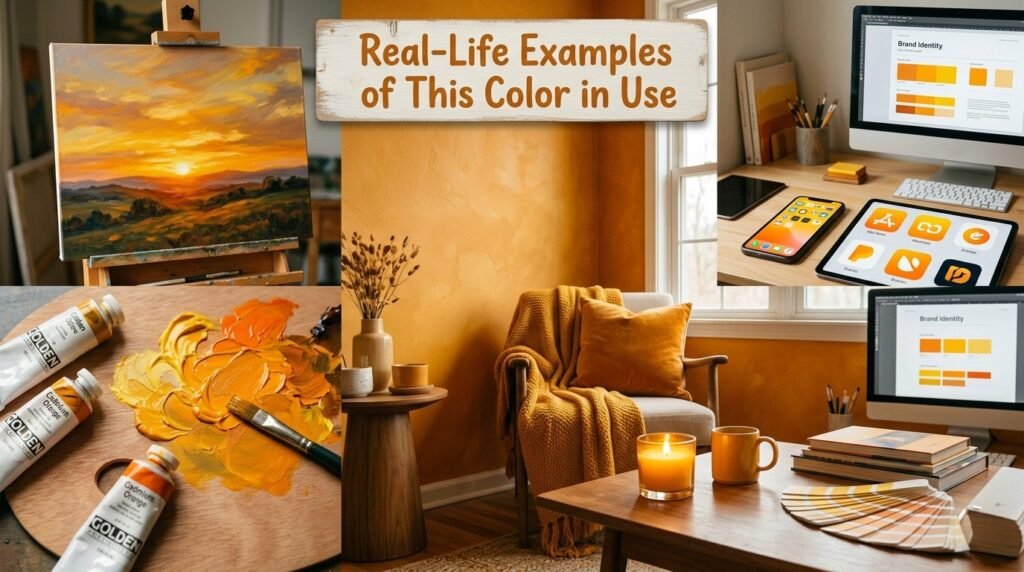
Traditional Art: Landscape painters mix their own yellow-oranges to capture the exact glow of a sunset, a candle flame, or golden-hour light. Pre-mixed oranges often look flat compared to a hand-blended marigold.
Interior Design: Amber and marigold accents bring warmth into living rooms, kitchens, and dining spaces. Designers often reach for this exact orange-yellow blend when clients want “cozy but vibrant.”
Digital Media: App icons and brand logos often use a yellow-orange gradient made by blending orange and yellow digitally. It signals energy, warmth, and optimism.
What Happens When You Add White or Gray (Modifiers)?
Once you know what color does orange and yellow make, the next step is adjusting it.
Adding White: White lightens yellow-orange into a soft peach-gold or pastel marigold. It also increases opacity, making the color feel airy.
- Example hex: #FFE0A3 (soft peach-gold)
Adding Gray: Gray mutes yellow-orange into a dusty, vintage-looking mustard tone. This works well for elegant, understated designs.
- Example hex: #C2A15C (muted mustard-gray)
These two modifiers open the door to an entire family of shades, all starting from the same orange-and-yellow base.
Paint vs. Digital Media: A Closer Comparison
Paint and digital screens create yellow-orange through similar-feeling but technically different processes.
(Subtractive): Cadmium Orange + Cadmium Yellow = classic marigold, hex approximately #FFB300. This mix reflects only warm, yellow-orange wavelengths back to your eye.
Digital (Additive): Orange light + Yellow light = bright glowing yellow-orange, hex close to #FFB84D. On screens, this shade is created by boosting the red and green channels while keeping blue low, producing a vivid, warm result.
If you’re designing for print, think in paint terms. If you’re designing for screens, think in RGB light terms. Confusing the two often leads to colors that look different than expected once printed.
Tips for Artists Mixing Orange and Yellow
- Use black sparingly. A little goes a long way, and too much flattens your yellow-orange
- Test on a white palette first. White reveals the true color, unlike a colored surface
- Layer glazes instead of flat mixing. Thin, transparent layers of yellow over orange (or vice versa) create richer depth than a single flat mix
- Keep your brushes clean. Leftover blue or purple on a brush can quickly dull a yellow-orange mix
- Work in natural light. Studio lighting can trick your eye into misjudging a warm, glowing shade
This Yellow-Orange Shade in Fashion and Interior Design
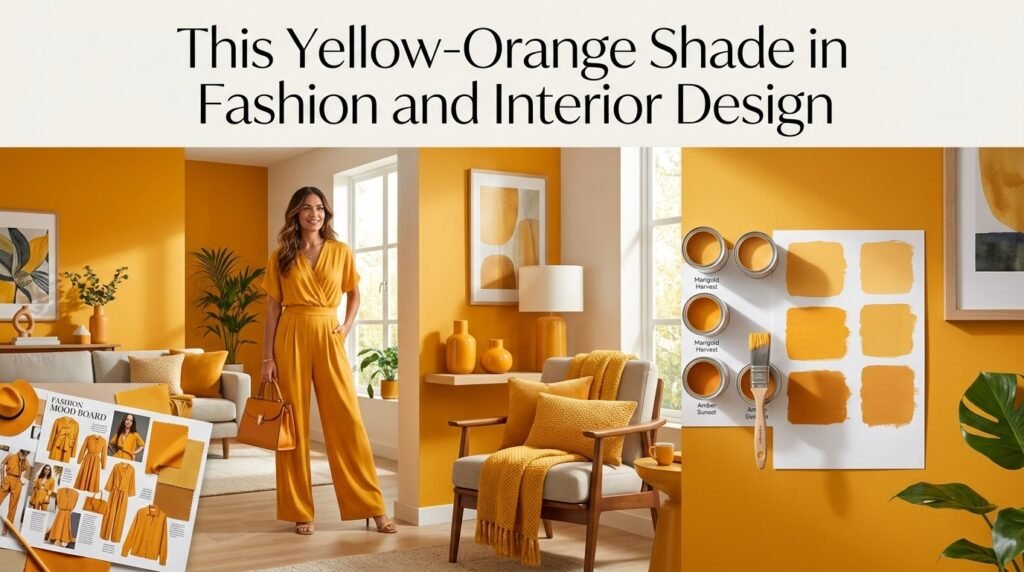
Yellow-orange, born from orange and yellow, carries a reputation for warmth and vibrancy. Fashion designers use marigold and amber tones in statement pieces to signal confidence and cheerfulness. Interior designers use it in accent walls, textiles, and ceramics.
If you’re planning a home refresh and want this exact tone, testing a few sample paint pots before committing to a full wall is always the smart move. Small swatches under your actual room lighting reveal far more than a color chart ever will.
Where This Color Sits on the Color Wheel
On a traditional color wheel, yellow-orange sits directly between orange and yellow. That makes it a tertiary color.
- Complementary color: Blue-violet sits opposite yellow-orange, creating high contrast when paired together
- Analogous colors: Orange and yellow themselves sit on either side of yellow-orange, creating a smooth, harmonious warm palette
Understanding this placement helps you predict how yellow-orange will interact with other colors in a design or painting.
Color Psychology and Meaning
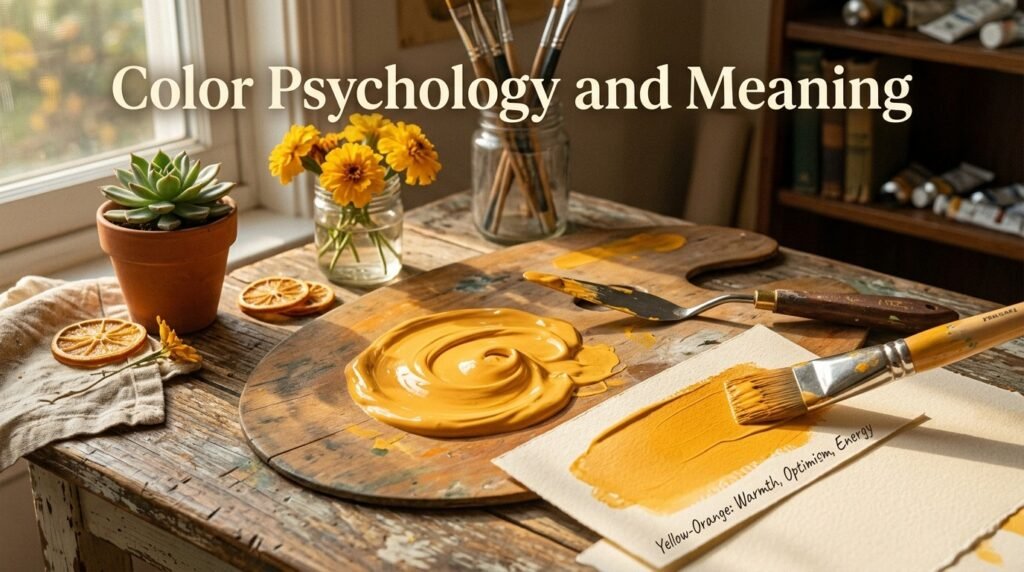
Yellow-orange carries strong symbolic weight. It represents warmth, optimism, and energy. Historically, this shade has been linked to sunshine, harvest, and celebration.
Modern brands still lean on this meaning. Fanta uses a bright yellow-orange to feel fun and energetic. Nickelodeon uses a similar tone to feel playful and youthful. Amazon’s smile logo uses a warm orange-yellow to feel friendly and approachable.
“Yellow-orange whispers warmth the way the last light of day settles over a room,” one designer once said, describing how the color feels both glowing and comforting at once.
Conclusion
So, what color does orange and yellow make? In paint, the answer is yellow-orange, shifting between soft marigold, golden amber, and deep sunset tones depending on your ratio. In light, the answer stays close to the same family, producing a bright, glowing yellow-orange through additive mixing instead of subtractive mixing.
Watch out for muddy results. They usually come from clashing undertones, overmixing, or low-quality black pigment. With the right pigments and a little practice, you can consistently create a clean, glowing yellow-orange every time.
Next time someone asks what color does orange and yellow make, you’ll have the full picture, not just the short answer.
FAQs
What color does orange and yellow make when mixed?
Orange and yellow make yellow-orange, often called amber or marigold, when mixed as paint.
What color does orange and yellow make in light?
Orange and yellow light make a bright, glowing yellow-orange through additive color mixing, similar in family to the paint result.
What color do orange and yellow paint mixed together create at a 1:1 ratio?
An equal mix of orange and yellow paint creates a balanced marigold, close to hex #FFB300.
Why does my orange and yellow mix look dull instead of glowing?
This usually happens due to undertone clashes or a heavy hand with black pigment. Try matching a warm, golden-leaning yellow with a bright orange instead.
Does more orange or more yellow create a brighter result?
Adding more yellow brightens the mix toward golden yellow-orange, while adding more orange deepens it toward warm amber.
What color does orange and yellow make besides marigold?
Depending on the ratio, you can also get amber, honey gold, tangerine-gold, or sunflower yellow by adjusting the mix or adding white and gray.
Is yellow-orange a primary, secondary, or tertiary color?
Yellow-orange is a tertiary color. It’s created by mixing a primary color, yellow, with a secondary color, orange.