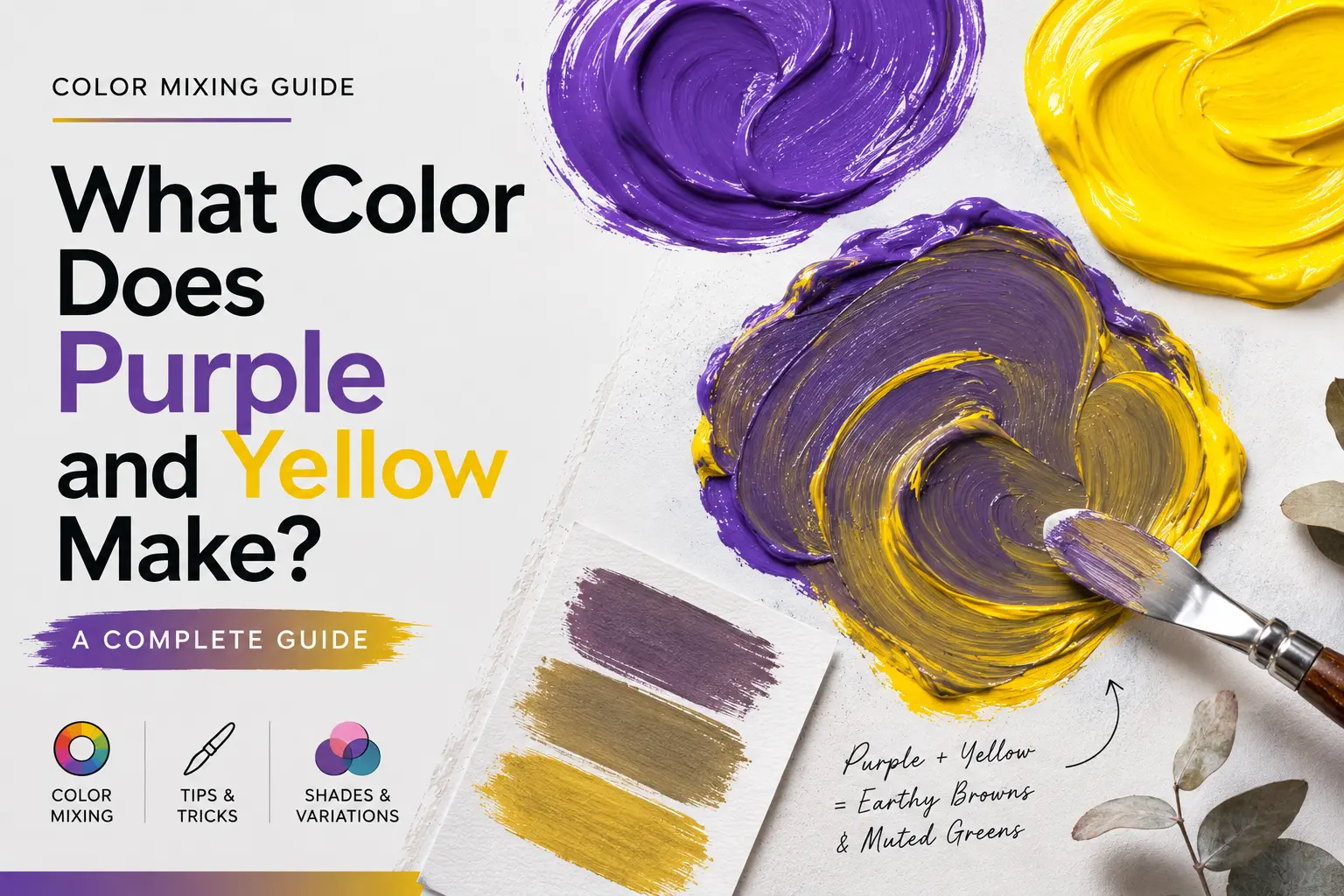
What Color Does Purple and Yellow Make? A Complete Guide
So, what color does purple and yellow make? The short answer might surprise you. Purple and yellow make brown or gray, not a bright new color. That’s it. But the exact shade depends on a lot of small details.
Main Takeaway: Mixing purple and yellow paint creates a muted brown or gray tone. The exact result shifts between warm khaki, cool taupe, and deep umber depending on the ratio you use.
This guide breaks down every part of that answer. You’ll learn the paint mix, the light mix, the ratios, the hex codes, and the common mistakes that make this mix turn out darker than expected. Let’s dive in.
Understanding Purple and Yellow as Colors
Before we answer what color purple and yellow make when mixed, it helps to know what these two colors actually are.
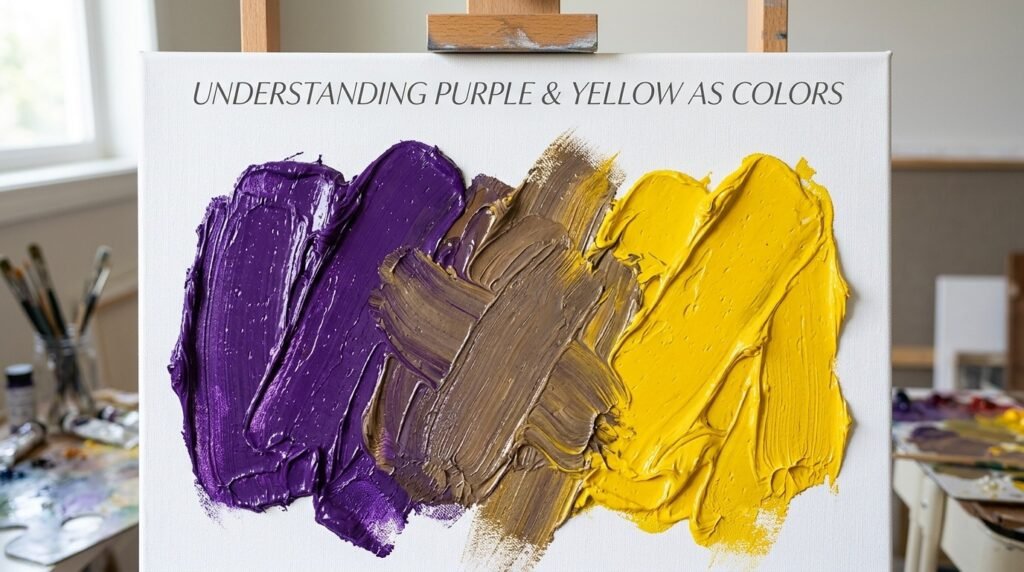
Yellow is a primary color. It can’t be created by mixing other colors. It’s a starting point. Purple, on the other hand, is a secondary color, made by mixing red and blue. This difference matters a lot.
Even more importantly, purple and yellow sit directly opposite each other on the color wheel. That makes them complementary colors. Complementary colors don’t blend into a bold new hue. Instead, they cancel each other out, moving toward a neutral tone like brown or gray.
This pairing matters because it behaves differently from most other color combinations. Instead of creating vibrancy, it creates balance and calm.
“Think of purple and yellow like two opposing magnets,” one art teacher once said. “Push them together, and instead of a new color, you get a quiet, neutral middle ground.”
What Color Do You Get When You Mix Purple and Yellow Paint?
Here’s where things get practical. What color does purple and yellow make in real paint, not just theory? Let’s look at three simple ratios.
1:1 Ratio (Equal Parts): Mix one part purple with one part yellow. You get a balanced warm gray-brown. This is the classic “neutralizing” result you see when complementary colors meet.
- Hex code: #8A7B6C
- Use case: Shading, shadow tones, muted background colors
2:1 Ratio (More Purple): Add two parts purple to one part yellow. The mix leans cooler and deeper. You get a plum-brown, close to a rich umber.
- Hex code: #5C4A42
- Use case: Deep shadows, wood tones, moody backgrounds
1:2 Ratio (More Yellow): Add two parts yellow to one part purple. The mix leans warmer and lighter. You get an olive-khaki, close to a muted gold-brown.
- Hex code: #9B8B4D
- Use case: Earthy florals, military-inspired design, autumn palettes
Beginner Tip: Don’t expect a bright, exciting color from this mix. Purple and yellow are complementary, so the goal is a soft, neutral tone. If you want vibrancy, use less of one color to let the other dominate slightly.
Full Mixing Chart: Purple and Yellow Paint Combinations
If you want exact results, use this chart. It shows what happens when purple and yellow paint are mixed in different pigment combinations.
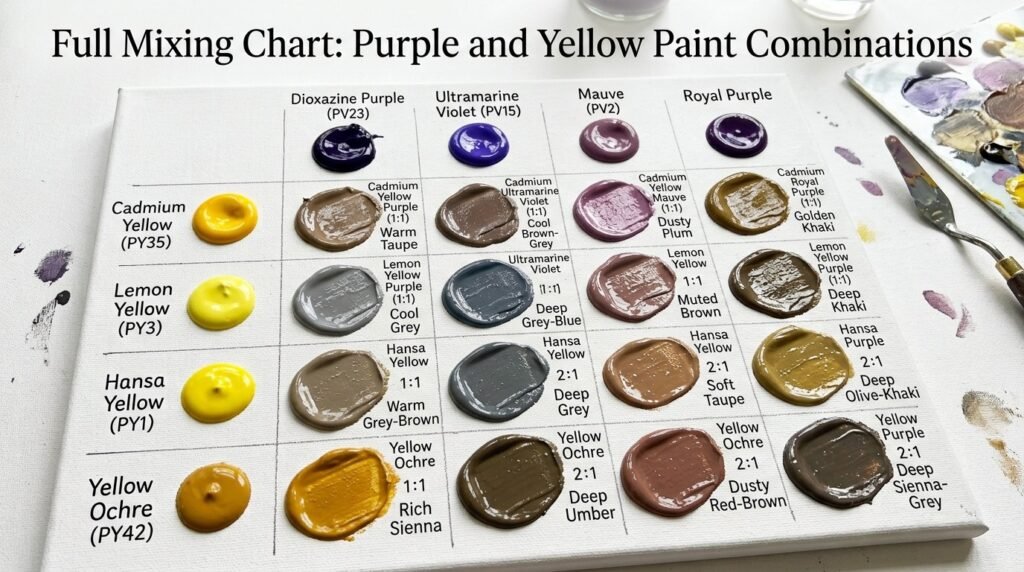
| Purple Pigment | Yellow Pigment | Ratio | Resulting Color | Hex Code |
| Dioxazine Purple | Cadmium Yellow | 1:1 | Warm Taupe | #8A7B6C |
| Dioxazine Purple | Lemon Yellow | 1:1 | Cool Gray-Brown | #7C7267 |
| Ultramarine Violet | Cadmium Yellow | 1:1 | Soft Umber | #6E5B4F |
| Ultramarine Violet | Lemon Yellow | 1:1 | Muted Olive-Gray | #7A7A5C |
| Dioxazine Purple | Cadmium Yellow | 2:1 | Deep Plum-Brown | #5C4A42 |
| Dioxazine Purple | Cadmium Yellow | 1:2 | Golden Khaki | #9B8B4D |
| Mauve | Hansa Yellow | 1:1 | Dusty Rose-Brown | #A18C7B |
| Royal Purple | Cadmium Yellow | 1:1 | Dark Chocolate Brown | #4A3B32 |
| Dioxazine Purple | Hansa Yellow | 1:1 | Vivid Umber | #6B5645 |
| Violet | Yellow Ochre | 1:1 | Earthy Sienna-Gray | #7D6A52 |
| Mauve | Cadmium Yellow | 1:1 | Light Mushroom Gray | #9B8D7D |
Notice how the pigment brand changes the result. This is a key part of understanding what color purple and yellow make when mixed in real-world painting, not just theory.
What Color Do Purple and Yellow Light Make?
Paint is not the only way to mix color. Light works differently. So, what color do purple and yellow light make?
This question uses additive color mixing, not subtractive mixing. Paint mixing removes light. Light mixing adds it. These are opposite systems, and the result here is very different from paint.
When you mix purple light and yellow light, you get something close to white or a very pale warm gray, not brown. Purple light already contains red and blue wavelengths, while yellow light contains red and green wavelengths. Combined, they cover almost the entire visible spectrum, pushing the result toward white.
- Hex code: #F5F0E8 (soft warm white)
This is the RGB model at work. Screens, LEDs, and stage lights all rely on this system.
Where this shows up:
- Screens: TVs, phones, and monitors mix red, green, and blue light to create every shade you see, including near-white blends like this one
- LED lighting: Event designers sometimes combine purple and yellow-amber LEDs to create a soft, warm-white wash
- Theater and stage lighting: Lighting designers mix complementary gels, like purple and yellow, to neutralize color casts and create balanced, natural-looking light
“Mixing complementary light is like combining two halves of a spectrum,” a lighting designer once explained. “Together, they fill in almost every gap, until white light appears.”
Subtractive vs. Additive Mixing: A Side-by-Side Comparison
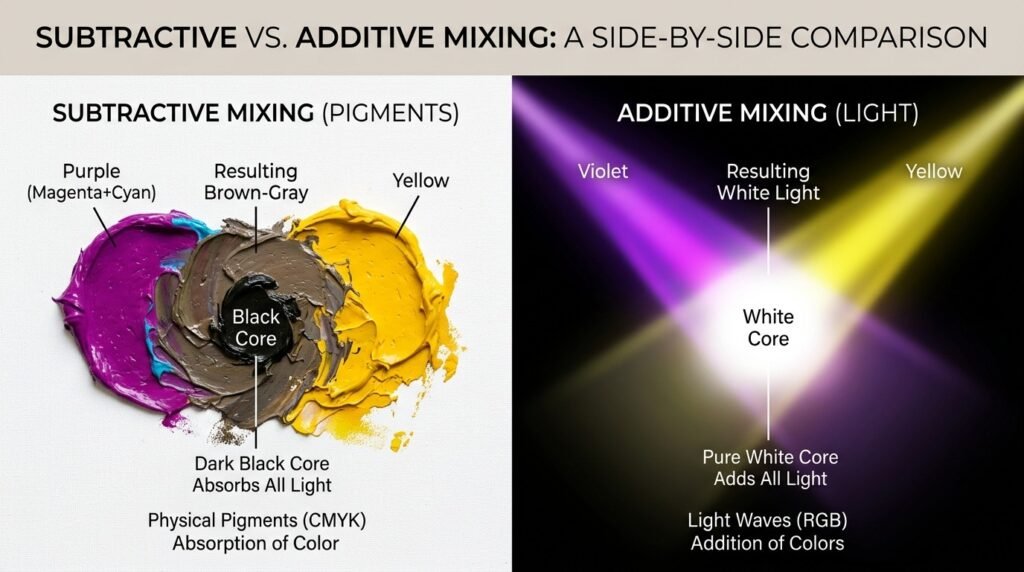
| Feature | Subtractive (Paint) | Additive (Light) |
| Base colors | Red, Blue, Yellow | Red, Green, Blue |
| Purple + Yellow result | Brown or Gray | White or Near-White |
| How it works | Removes wavelengths | Adds wavelengths |
| Common use | Painting, printing | Screens, stage lighting |
| More color added = | Darker result | Brighter result |
| Final mix of all colors | Black | White |
This table makes the difference clear. Paint and light behave in almost opposite ways, even when the starting colors are the same.
How Ratio Affects the Final Color
Ratio is everything. Small changes shift the mood of your neutral completely.
| Ratio (Purple: Yellow) | Resulting Color | Use Case |
| 3:1 | Deep Plum-Brown | Moody shadows, dark backgrounds |
| 2:1 | Rich Umber | Wood tones, warm shading |
| 1:1 | Balanced Gray-Brown | General neutral mixing |
| 1:2 | Golden Khaki | Earthy florals, autumn palettes |
| 1:3 | Soft Olive-Gold | Light, muted highlights |
| Equal + extra pigment | Near-Black Brown | Deep shadows, outlines |
As you add more pigment overall, the mix gets darker. Push it too far, and you’ll edge toward a near-black brown. This happens because layering too much of two complementary colors absorbs almost all reflected light.
Why Your Mix Looks Muddy or Flat — and How to Fix It
Sometimes your neutral tone doesn’t look right. It looks dull, dirty, or lifeless instead of rich and warm. Here’s why.
Problem 1: Undertone Clashes. Not all purples and yellows are equal. Some carry warm undertones. Some carry cool undertones. Mixing a cool-toned purple with a warm-toned yellow can create a flatter, dirtier result. Fix: Match undertones intentionally. If you want a warm brown, pair a warm purple with a warm yellow.
Problem 2: Overmixing. Stirring too long, or adding too many small corrections, can dull your color further than intended. Fix: Mix gently. Since this combination already trends neutral, stop as soon as you reach the tone you want.
Problem 3: Cheap Black Pigment. Some painters add black to darken this mix even further. Cheap black often contains muddy undertones, which can make the result look lifeless. Fix: Darken the mix with a small amount of extra purple or a touch of blue instead of black.
Beginner Tip: If your mix looks too flat, don’t panic. Add a tiny bit of white first. This often reveals whether the mix is truly muddy or just needs light to shine through.
Best Pigments to Mix for Clean Results
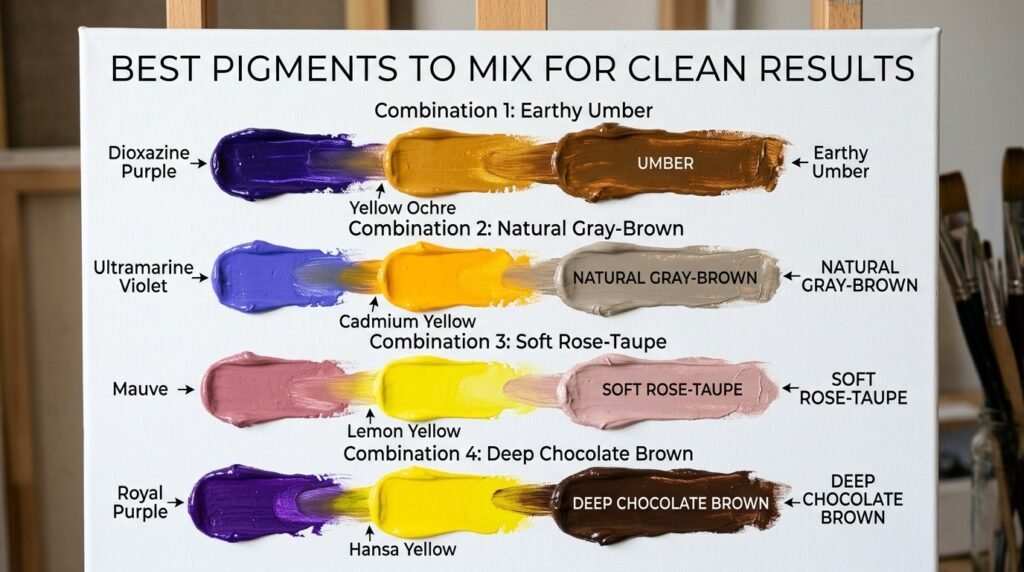
| Purple Pigment | Yellow Pigment | Result Description |
| Dioxazine Purple | Yellow Ochre | Rich, earthy umber with warm depth |
| Ultramarine Violet | Cadmium Yellow | Balanced, natural gray-brown |
| Mauve | Lemon Yellow | Soft, slightly muted rose-taupe |
| Royal Purple | Hansa Yellow | Deep, dramatic chocolate brown |
Mixing Tips:
- Test small amounts on a white palette before committing to a full batch
- Add yellow slowly, one drop at a time, to control warmth
- Use a palette knife instead of a brush for more even blending
- Keep a reference chart nearby so you don’t lose track of ratios
Real-Life Examples of This Color in Use
The neutrals created from purple and yellow show up everywhere.
Traditional Art: Portrait and landscape painters often mix their own shadow tones from complementary colors like purple and yellow. This creates richer, more natural shadows than pre-mixed browns or grays.
Interior Design: Warm taupe and umber walls create a grounded, sophisticated feel in living rooms and offices. Designers often reach for this exact purple-yellow blend when clients want “warm but neutral.”
Digital Media: Brand palettes sometimes use a muted olive-brown gradient made from blending purple and yellow digitally. It signals sophistication, earthiness, and understated style.
What Happens When You Add White or Gray (Modifiers)?
Once you know what color does purple and yellow make, the next step is adjusting it.
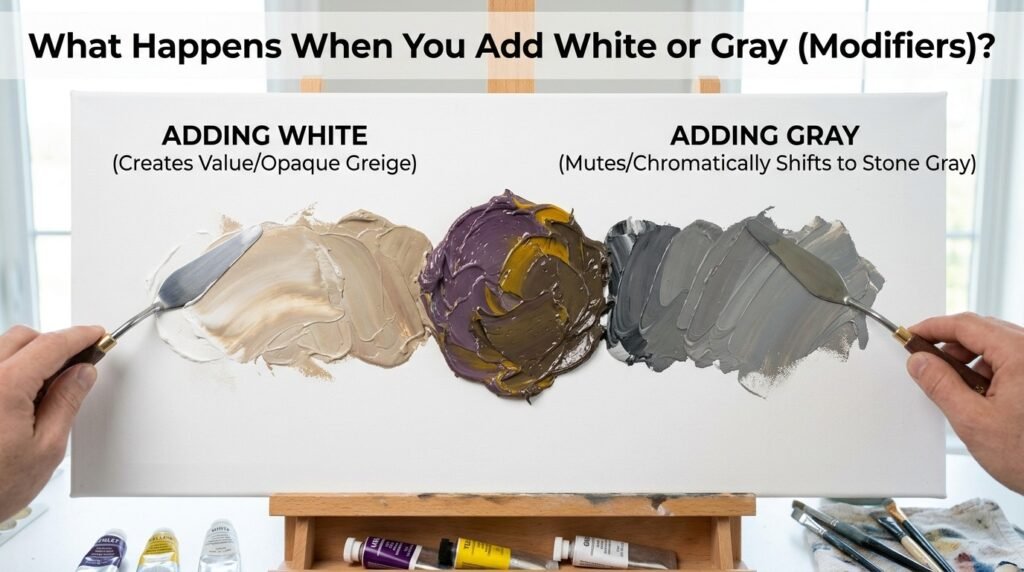
Adding White: White lightens this neutral into a soft greige or warm putty tone. It also increases opacity, making the color feel airy.
- Example hex: #D9CFC1 (soft greige)
Adding Gray: Gray mutes the mix into a cooler, more understated stone tone. This works well for minimalist, modern designs.
- Example hex: #9C9689 (muted stone-gray)
These two modifiers open the door to an entire family of shades, all starting from the same purple-and-yellow base.
Paint vs. Digital Media: A Closer Comparison
Paint and digital screens create this neutral tone through completely different processes, even when the end goal looks similar.
(Subtractive): Dioxazine Purple + Cadmium Yellow = warm taupe, hex approximately #8A7B6C. This mix reflects only muted, neutral wavelengths back to your eye.
Digital (Additive): Purple light + Yellow light = near-white, hex close to #F5F0E8. On screens, a true brown or taupe is created differently, by lowering brightness and saturation across all three RGB channels, not by combining purple and yellow directly.
If you’re designing for print, think in paint terms. If you’re designing for screens, think in RGB light terms. Confusing the two often leads to colors that look different than expected once printed.
Tips for Artists Mixing Purple and Yellow
- Use black sparingly. This mix is already neutral, so too much black can make it lifeless
- Test on a white palette first. White reveals the true color, unlike a colored surface
- Layer glazes instead of flat mixing. Thin, transparent layers of purple over yellow (or vice versa) create richer depth than a single flat mix
- Keep your brushes clean. Leftover green or orange on a brush can quickly shift this neutral mix
- Work in natural light. Studio lighting can trick your eye into misjudging a subtle neutral tone
This Neutral Shade in Fashion and Interior Design
The brown and gray tones born from purple and yellow carry a reputation for understated elegance. Fashion designers use these neutrals in tailored pieces to signal sophistication without shouting for attention. Interior designers use them in accent walls, upholstery, and statement furniture.
If you’re planning a home refresh and want this exact tone, testing a few sample paint pots before committing to a full wall is always the smart move. Small swatches under your actual room lighting reveal far more than a color chart ever will.
Where This Color Sits on the Color Wheel
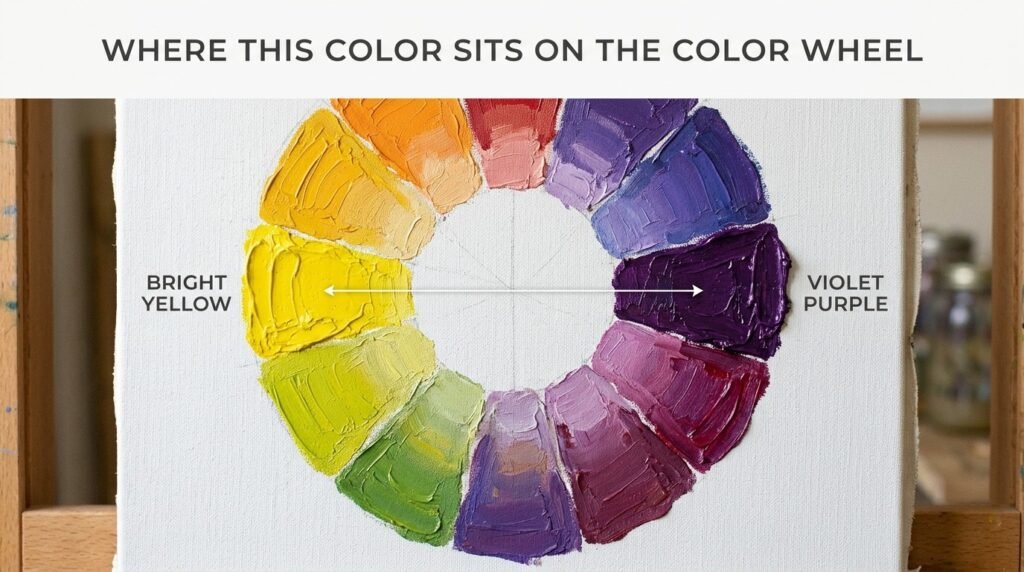
On a traditional color wheel, purple and yellow sit directly opposite one another. That makes them complementary colors, not analogous ones.
- Complementary relationship: Purple and yellow are already complements of each other, which is exactly why mixing them creates a neutral tone instead of a vibrant new hue
- Analogous colors: If you want vibrancy instead of neutrality, pair yellow with orange or green, or pair purple with blue or magenta
Understanding this placement helps you predict how purple and yellow will interact, both when mixed and when placed side by side in a design.
Color Psychology and Meaning
The neutral tones created from purple and yellow carry quiet symbolic weight. They represent balance, sophistication, and earthiness. Historically, muted browns and taupes have been linked to stability and craftsmanship.
Modern brands still lean on this meaning. UPS uses a deep brown to feel dependable and grounded. Many luxury interior brands use warm taupe to feel calm and expensive. Coffee and craft brands often use olive-brown palettes to feel authentic and artisanal.
“This neutral whispers balance the way two opposing forces settle into calm,” one designer once said, describing how the color feels both grounded and refined at once.
Conclusion
So, what color does purple and yellow make? In paint, the answer is a muted brown or gray, shifting between warm taupe, deep umber, and golden khaki depending on your ratio. In light, the answer is closer to white, created through additive mixing instead of subtractive mixing.
Watch out for overly muddy or flat results. They usually come from clashing undertones, overmixing, or low-quality black pigment. With the right pigments and a little practice, you can consistently create a rich, warm neutral every time.
Next time someone asks what color does purple and yellow make, you’ll have the full picture, not just the short answer.
FAQs
What color does purple and yellow make when mixed?
Purple and yellow make a muted brown or gray when mixed as paint, since they are complementary colors that neutralize each other.
What color does purple and yellow make in light?
Purple and yellow light make a near-white or soft warm gray through additive color mixing.
What color do purple and yellow paint mixed create at a 1:1 ratio?
An equal mix of purple and yellow paint creates a balanced warm gray-brown, close to hex #8A7B6C.
Why does my purple and yellow mix look muddy or lifeless?
This usually happens due to undertone clashes or a heavy hand with black pigment. Try matching warm-toned purple with warm-toned yellow instead.
Does more purple or more yellow create a darker result?
Adding more purple deepens the mix toward plum-brown, while adding more yellow lightens it toward golden khaki.
What color does purple and yellow make besides brown? Depending on the ratio, you can also get taupe, khaki, umber, or stone-gray by adjusting the mix or adding white and gray.
Why do purple and yellow create a neutral color instead of a new bright one? Purple and yellow sit opposite each other on the color wheel as complementary colors. Mixing complements cancels out vibrancy, producing brown or gray instead of a new hue.