127 Colors That Start With P: Names, Hex Codes & Shades
Prussian blue began as a mistake. A pigment maker in Berlin set out to make red and got blue instead. That is just one of the stories hiding in the colors that start with P. Puce is the French word for flea. Peridot is named for a gemstone. Pistachio is named for a nut. This guide lists 127 colors. Each has a hex code, an RGB value, and a CMYK value. Every name comes from a real source. We did not invent shades or pad the list.
We sorted the P color names by family. Each group has contrast scores. Four groups have a ready palette.
The Families Behind Colors That Start With P
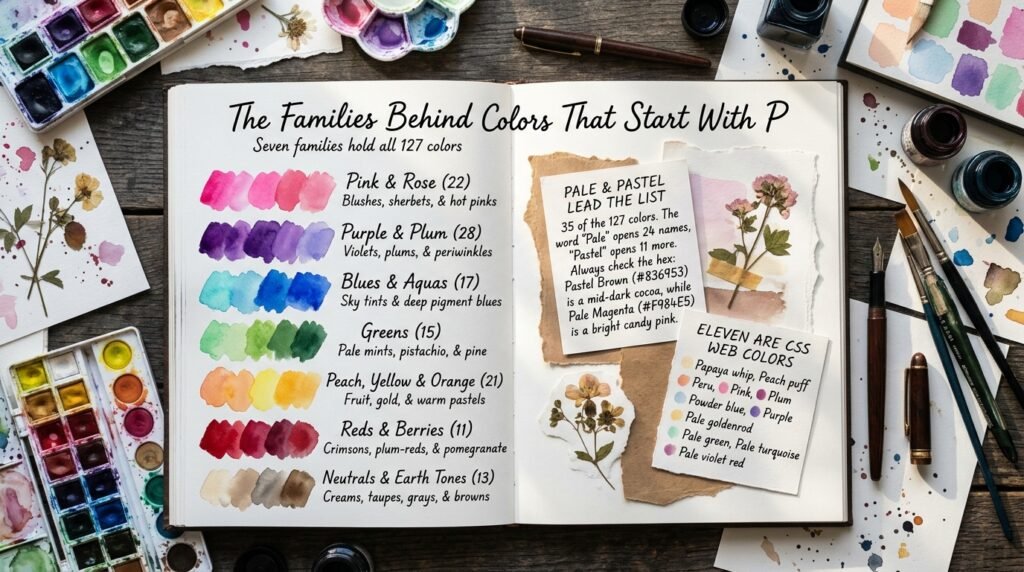
Seven families hold all 127 colors.
| Family | Colors | What ties them together |
| Pink and rose | 22 | Blushes, sherbets, and hot pinks |
| Purple and plum | 28 | Violets, plums, and periwinkles |
| Blues and aquas | 17 | Sky tints and deep pigment blues |
| Greens | 15 | Pale mints, pistachio, and pine |
| Peach, yellow, and orange | 21 | Fruit, gold, and warm pastels |
| Reds and berries | 11 | Crimsons, plum-reds, and pomegranate |
| Neutrals and earth tones | 13 | Creams, taupes, grays, and browns |
Pale and Pastel Lead the List
The word Pale opens 24 names. The word Pastel opens 11 more. Together they make 35 of the 127 colors. Do not trust the adjective alone. Pastel brown is a mid-dark cocoa (#836953). Pale magenta is a bright candy pink (#F984E5). Always check the hex code.
Eleven Are Web Colors
CSS names 11 colors that start with P. Four begin with the word Pale. They are Pale goldenrod, Pale green, Pale turquoise, and Pale violet red. The other seven are Papaya whip, Peach puff, Peru, Pink, Plum, Powder blue, and Purple. You can type any of them straight into code.
Quick A–Z Index of All 127 Colors
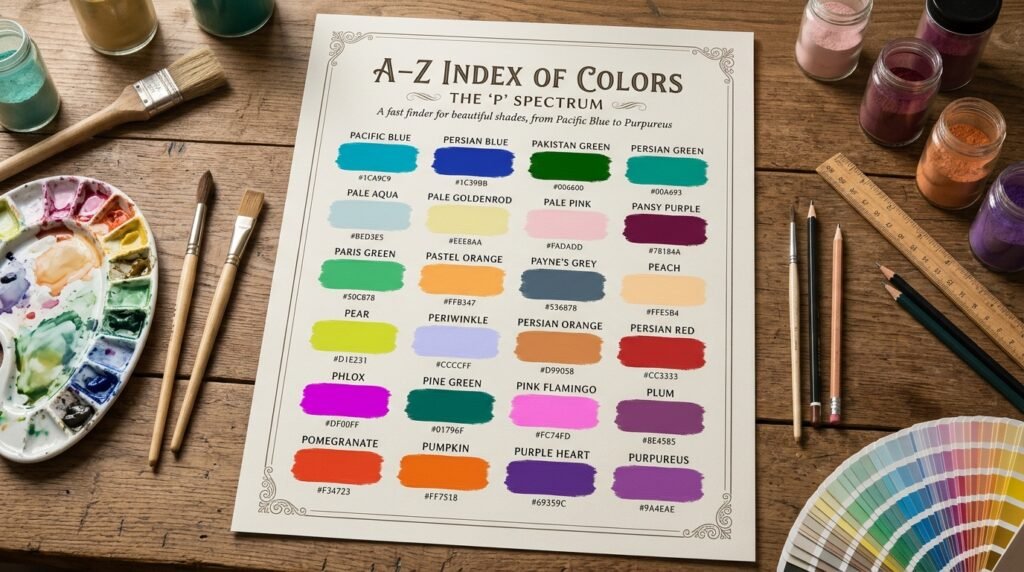
Find any shade fast. Full details follow, grouped by family.
| Color | Hex | Color | Hex |
| Pacific blue | #1CA9C9 | Persian blue | #1C39BB |
| Pakistan green | #006600 | Persian green | #00A693 |
| Palatinate blue | #273BE2 | Persian indigo | #32127A |
| Palatinate purple | #682860 | Persian orange | #D99058 |
| Pale aqua | #BED3E5 | Persian pink | #F77FBE |
| Pale azure | #87D3F8 | Persian plum | #701C1C |
| Pale brown | #987654 | Persian red | #CC3333 |
| Pale canary | #FFFF99 | Persian rose | #FE28A2 |
| Pale carmine | #AF4035 | Persimmon | #EC5800 |
| Pale cerulean | #9BC4E2 | Peru | #CD853F |
| Pale chestnut | #DDADAF | Pewter Blue | #8BA8B7 |
| Pale copper | #DA8A67 | Phlox | #DF00FF |
| Pale cornflower blue | #ABCDEF | Phthalo blue | #000F89 |
| Pale Dogwood | #ED7A9B | Phthalo green | #123524 |
| Pale gold | #E6BE8A | Picotee blue | #2E2787 |
| Pale goldenrod | #EEE8AA | Pictorial carmine | #C30B4E |
| Pale green | #98FB98 | Pig pink | #FDD7E4 |
| Pale lavender | #DCD0FF | Piggy pink | #FDDDE6 |
| Pale magenta | #F984E5 | Pigment blue | #333399 |
| Pale pink | #FADADD | Pigment green | #00A550 |
| Pale purple (Pantone) | #FAE6FA | Pigment red | #ED1C24 |
| Pale robin egg blue | #96DED1 | Pine green | #01796F |
| Pale silver | #C9C0BB | Pine tree | #2A2F23 |
| Pale spring bud | #ECEBBD | Pink | #FFC0CB |
| Pale taupe | #BC987E | Pink (Pantone) | #D74894 |
| Pale turquoise | #AFEEEE | Pink Flamingo | #FC74FD |
| Pale violet | #CC99FF | Pink lace | #FFDDF4 |
| Pale violet red | #DB7093 | Pink lavender | #D8B2D1 |
| Pansy purple | #78184A | Pink pearl | #E7ACCF |
| Paolo Veronese green | #009B7D | Pink Sherbet | #F78FA7 |
| Papaya whip | #FFEFD5 | Pink-orange | #FF9966 |
| Paprika | #8D0226 | Pistachio | #93C572 |
| Paradise pink | #E63E62 | Platinum | #E5E4E2 |
| Parchment | #F1E9D2 | Plum | #8E4585 |
| Paris Daisy | #FFF46E | Plum (web) | #DDA0DD |
| Paris Green | #50C878 | Plump Purple | #5946B2 |
| Pastel blue | #AEC6CF | Polished Pine | #5DA493 |
| Pastel brown | #836953 | Pomegranate | #F34723 |
| Pastel gray | #CFCFC4 | Pomp and Power | #86608E |
| Pastel green | #77DD77 | Popstar | #BE4F62 |
| Pastel magenta | #F49AC2 | Portland Orange | #FF5A36 |
| Pastel orange | #FFB347 | Powder blue | #B0E0E6 |
| Pastel pink | #DEA5A4 | Prairie gold | #E1CA7A |
| Pastel purple | #B39EB5 | Princeton orange | #F58025 |
| Pastel red | #FF6961 | Process yellow | #FFEF00 |
| Pastel violet | #CB99C9 | Prune | #701C1C |
| Pastel yellow | #FDFD96 | Prussian blue | #003153 |
| Paua | #1F005E | Psychedelic purple | #DF00FF |
| Payne’s grey | #536878 | Puce | #CC8899 |
| Peach | #FFE5B4 | Pullman Brown (UPS Brown) | #644117 |
| Peach (Crayola) | #FFCBA4 | Pullman green | #3B331C |
| Peach puff | #FFDAB9 | Pumpkin | #FF7518 |
| Peach-orange | #FFCC99 | Purple | #6A0DAD |
| Peach-yellow | #FADFAD | Purple (Munsell) | #9F00C5 |
| Pear | #D1E231 | Purple (web) | #800080 |
| Pearl | #EAE0C8 | Purple (X11) | #A020F0 |
| Pearl aqua | #88D8C0 | Purple Heart | #69359C |
| Pearly purple | #B768A2 | Purple mountain majesty | #9678B6 |
| Penn blue | #011F5B | Purple navy | #4E5180 |
| Penn red | #990000 | Purple pizzazz | #FE4EDA |
| Peridot | #E6E200 | Purple Plum | #9C51B6 |
| Periwinkle | #CCCCFF | Purple taupe | #50404D |
| Periwinkle (Crayola) | #C3CDE6 | Purpureus | #9A4EAE |
| Permanent Geranium Lake | #E12C2C |
Pink and Rose: Blushes, Sherbets, and Hot Pinks
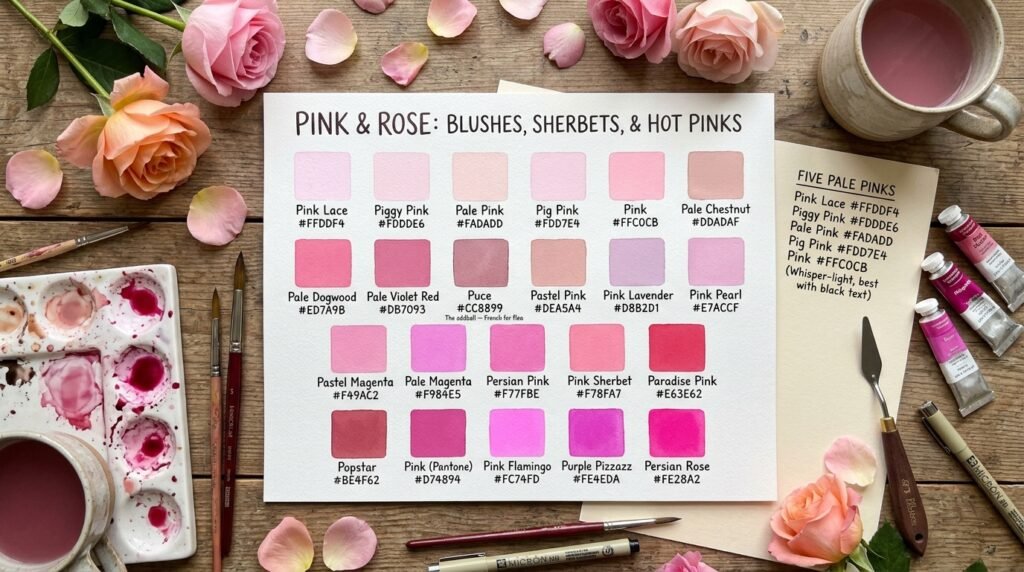
Twenty-two pinks fill this group. Some are whisper-light. Some glow like neon. Puce is the oddball. Its name is the French word for flea.
| Color | Hex | RGB | CMYK (approx.) | Quick note |
| Pale chestnut | #DDADAF | 221, 173, 175 | 0, 22, 21, 13 | A dusty blush with a brown-gray undertone. Black text scores 10.7:1. |
| Pale Dogwood | #ED7A9B | 237, 122, 155 | 0, 49, 35, 7 | Mid-tone rose pink, bolder than its name. Black text scores 7.9:1. |
| Pale magenta | #F984E5 | 249, 132, 229 | 0, 47, 8, 2 | Light, bubblegum-leaning magenta. Black text scores 9.5:1. |
| Pale pink | #FADADD | 250, 218, 221 | 0, 13, 12, 2 | A whisper of blush. Black text scores 16.1:1. |
| Pale violet red | #DB7093 | 219, 112, 147 | 0, 49, 33, 14 | A CSS name. Dusty rose with a mauve lean. Black text scores 6.8:1. |
| Paradise pink | #E63E62 | 230, 62, 98 | 0, 73, 57, 10 | Saturated watermelon pink with real punch. Black text scores 5.2:1. |
| Pastel magenta | #F49AC2 | 244, 154, 194 | 0, 37, 20, 4 | Soft bubblegum with a faint purple cast. Black text scores 10.2:1. |
| Pastel pink | #DEA5A4 | 222, 165, 164 | 0, 26, 26, 13 | Muted rose-beige. Calmer than most pinks. Black text scores 10.0:1. |
| Persian pink | #F77FBE | 247, 127, 190 | 0, 49, 23, 3 | Sweet and bright, with a cool fuchsia edge. Black text scores 8.7:1. |
| Persian rose | #FE28A2 | 254, 40, 162 | 0, 84, 36, 0 | Hot pink that vibrates against dark navy. Black text scores 6.0:1. |
| Pig pink | #FDD7E4 | 253, 215, 228 | 0, 15, 10, 1 | Pale, cool-leaning pastel. Twin of Piggy pink. Black text scores 16.0:1. |
| Piggy pink | #FDDDE6 | 253, 221, 230 | 0, 13, 9, 1 | One breath lighter than Pig Pink. Black text scores 16.7:1. |
| Pink | #FFC0CB | 255, 192, 203 | 0, 25, 20, 0 | The CSS keyword. Light and friendly. Black text scores 13.7:1. |
| Pink (Pantone) | #D74894 | 215, 72, 148 | 0, 67, 31, 16 | Deep orchid pink, far stronger than CSS pink. Black text scores 5.2:1. |
| Pink Flamingo | #FC74FD | 252, 116, 253 | 0, 54, 0, 1 | Electric pink-violet that glows on dark backgrounds. Black text scores 9.1:1. |
| Pink lace | #FFDDF4 | 255, 221, 244 | 0, 13, 4, 0 | Near-white with a lilac-pink cast. Black text scores 16.9:1. |
| Pink lavender | #D8B2D1 | 216, 178, 209 | 0, 18, 3, 15 | A dusty in-between of pink and lilac. Black text scores 11.2:1. |
| Pink pearl | #E7ACCF | 231, 172, 207 | 0, 26, 10, 9 | Soft orchid pink with a cool, pearly finish. Black text scores 11.2:1. |
| Pink Sherbet | #F78FA7 | 247, 143, 167 | 0, 42, 32, 3 | Warm, berry-sorbet pink. Black text scores 9.4:1. |
| Popstar | #BE4F62 | 190, 79, 98 | 0, 58, 48, 25 | A muted raspberry. A grown-up pink. White text scores 4.7:1. |
| Puce | #CC8899 | 204, 136, 153 | 0, 33, 25, 20 | Dusty mauve-pink. The name is French for flea. Black text scores 7.5:1. |
| Purple pizzazz | #FE4EDA | 254, 78, 218 | 0, 69, 14, 0 | Neon magenta-pink. Loud on purpose. Black text scores 7.3:1. |
Five Pale Pinks
Five pink names sit very close together. Each one is a light tint. Only the hex code tells them apart.
| Name | Hex | Look | Black text contrast |
| Pink lace | #FFDDF4 | Near-white lilac-pink | 16.9:1 |
| Piggy pink | #FDDDE6 | Pale, cool pastel | 16.7:1 |
| Pale pink | #FADADD | Soft, warm blush | 16.1:1 |
| Pig pink | #FDD7E4 | A shade deeper than Piggy pink | 16.0:1 |
| Pink | #FFC0CB | Light, friendly pink | 13.7:1 |
All five need black text. White text scores between 1.2:1 and 1.5:1, so it fails on every one.
Purple and Plum: Violets, Plums, and Periwinkles
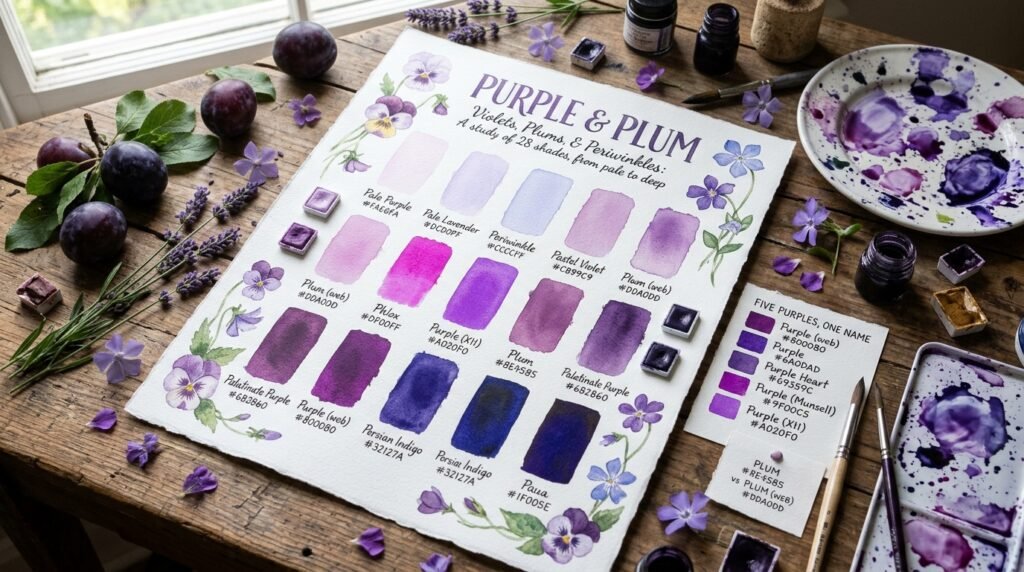
Twenty-eight shades make this the biggest group. Purple is the most confusing P name. Five entries use the word, and each one looks different. In CSS, the keyword purple means #800080. The older X11 purple is brighter and bluer.
| Color | Hex | RGB | CMYK (approx.) | Quick note |
| Palatinate purple | #682860 | 104, 40, 96 | 0, 62, 8, 59 | Deep plum with a wine undertone. White text scores 10.2:1. |
| Pale lavender | #DCD0FF | 220, 208, 255 | 14, 18, 0, 0 | An airy blue-lilac for backgrounds. Black text scores 14.5:1. |
| Pale purple (Pantone) | #FAE6FA | 250, 230, 250 | 0, 8, 0, 2 | Barely tinted lilac-pink. Black text scores 17.8:1. |
| Pale violet | #CC99FF | 204, 153, 255 | 20, 40, 0, 0 | Clear, soft violet. Livelier than lavender. Black text scores 9.6:1. |
| Pansy purple | #78184A | 120, 24, 74 | 0, 80, 38, 53 | Dark magenta-plum that reads close to burgundy. White text scores 10.4:1. |
| Pastel purple | #B39EB5 | 179, 158, 181 | 1, 13, 0, 29 | Gray-mauve with a vintage mood. Black text scores 8.5:1. |
| Pastel violet | #CB99C9 | 203, 153, 201 | 0, 25, 1, 20 | Dusty orchid with a pink lean. Black text scores 8.9:1. |
| Paua | #1F005E | 31, 0, 94 | 67, 100, 0, 63 | A midnight indigo-violet. White text scores 17.2:1. |
| Pearly purple | #B768A2 | 183, 104, 162 | 0, 43, 11, 28 | Warm orchid with a pink heart. Black text scores 5.5:1. |
| Periwinkle | #CCCCFF | 204, 204, 255 | 20, 20, 0, 0 | The classic pale blue-violet. Black text scores 13.6:1. |
| Periwinkle (Crayola) | #C3CDE6 | 195, 205, 230 | 15, 11, 0, 10 | Same name, but grayer and bluer. Black text scores 13.2:1. |
| Persian indigo | #32127A | 50, 18, 122 | 59, 85, 0, 52 | Rich blue-violet. White text scores 14.0:1. |
| Phlox | #DF00FF | 223, 0, 255 | 13, 100, 0, 0 | Electric magenta-violet. Same code as Psychedelic purple. Black text scores 5.6:1. |
| Plum | #8E4585 | 142, 69, 133 | 0, 51, 6, 44 | Muted, reddish purple. Earthy, not electric. White text scores 6.3:1. |
| Plum (web) | #DDA0DD | 221, 160, 221 | 0, 28, 0, 13 | The CSS plum is far lighter. A pale orchid. Black text scores 10.1:1. |
| Plump Purple | #5946B2 | 89, 70, 178 | 50, 61, 0, 30 | Medium blue-violet with a cool, modern feel. White text scores 7.1:1. |
| Pomp and Power | #86608E | 134, 96, 142 | 6, 32, 0, 44 | Dusty mauve with a quiet, regal air. White text scores 5.2:1. |
| Psychedelic purple | #DF00FF | 223, 0, 255 | 13, 100, 0, 0 | Twin of Phlox, with the same code. Black text scores 5.6:1. |
| Purple | #6A0DAD | 106, 13, 173 | 39, 92, 0, 32 | Deep, blue-leaning violet. White text scores 9.2:1. |
| Purple (Munsell) | #9F00C5 | 159, 0, 197 | 19, 100, 0, 23 | Vivid magenta-violet with no gray. White text scores 6.4:1. |
| Purple (web) | #800080 | 128, 0, 128 | 0, 100, 0, 50 | The CSS keyword. Dark and magenta-leaning. White text scores 9.4:1. |
| Purple (X11) | #A020F0 | 160, 32, 240 | 33, 87, 0, 6 | Brighter and bluer than CSS purple. White text scores 5.3:1. |
| Purple Heart | #69359C | 105, 53, 156 | 33, 66, 0, 39 | Medium-deep violet with a cool lean. White text scores 8.1:1. |
| Purple mountain majesty | #9678B6 | 150, 120, 182 | 18, 34, 0, 29 | Soft, dusty amethyst. Black text scores 5.7:1. |
| Purple navy | #4E5180 | 78, 81, 128 | 39, 37, 0, 50 | Slate blue with a hint of violet. White text scores 7.5:1. |
| Purple Plum | #9C51B6 | 156, 81, 182 | 14, 55, 0, 29 | Warm, friendly mid-tone orchid. White text scores 4.9:1. |
| Purple taupe | #50404D | 80, 64, 77 | 0, 20, 4, 69 | Dark gray-brown with a faint purple tint. White text scores 9.6:1. |
| Purpureus | #9A4EAE | 154, 78, 174 | 11, 55, 0, 32 | Nearly identical to Purple Plum. White text scores 5.2:1. |
Five Purples, One Name
Each color system defines purple in its own way.
| Name | Hex | Look | White text contrast |
| Purple (web) | #800080 | Dark, magenta-leaning | 9.4:1 |
| Purple | #6A0DAD | Deep, blue-leaning violet | 9.2:1 |
| Purple Heart | #69359C | Medium-deep, cool violet | 8.1:1 |
| Purple (Munsell) | #9F00C5 | Vivid magenta-violet | 6.4:1 |
| Purple (X11) | #A020F0 | Bright, electric violet | 5.3:1 |
All five pass the 4.5:1 test for white text. Still, never swap them. Check the hex first. Two Plums split the same way. Plum (web) (#DDA0DD) is a pale orchid.
Plum Evening: Palatinate Purple, Pale Lavender, and Pink Lace
#682860, #DCD0FF, and #FFDDF4. This set feels rich and soft. Pale lavender on Palatinate purple scores 7.0:1. Pink lace on Palatinate purple scores 8.2:1. Both pass the 4.5:1 test.
Blues and Aquas: From Sky Tints to Pigment Depths

Seventeen blues run from icy to inky. Prussian blue is the star. It was an early synthetic pigment, and its discovery was an accident. Phthalo blue takes its name from the phthalocyanine pigment family.
| Color | Hex | RGB | CMYK (approx.) | Quick note |
| Pacific blue | #1CA9C9 | 28, 169, 201 | 86, 16, 0, 21 | A lively, cyan-leaning blue. Black text scores 7.6:1. |
| Palatinate blue | #273BE2 | 39, 59, 226 | 83, 74, 0, 11 | Saturated royal blue with a violet edge. White text scores 7.5:1. |
| Pale aqua | #BED3E5 | 190, 211, 229 | 17, 8, 0, 10 | A quiet, cool blue-gray. Black text scores 13.6:1. |
| Pale azure | #87D3F8 | 135, 211, 248 | 46, 15, 0, 3 | Sunny, open sky blue. Black text scores 12.7:1. |
| Pale cerulean | #9BC4E2 | 155, 196, 226 | 31, 13, 0, 11 | A clean sky blue, a little grayer than Pale azure. Black text scores 11.4:1. |
| Pale cornflower blue | #ABCDEF | 171, 205, 239 | 28, 14, 0, 6 | Gentle spring blue. Its hex digits spell A-B-C-D-E-F. Black text scores 12.7:1. |
| Pale robin egg blue | #96DED1 | 150, 222, 209 | 32, 0, 6, 13 | Minty aqua that leans green. Black text scores 13.7:1. |
| Pale turquoise | #AFEEEE | 175, 238, 238 | 26, 0, 0, 7 | A CSS name. Icy and bright. Black text scores 16.3:1. |
| Pastel blue | #AEC6CF | 174, 198, 207 | 16, 4, 0, 19 | Calm gray-blue with a vintage feel. Black text scores 11.8:1. |
| Penn blue | #011F5B | 1, 31, 91 | 99, 66, 0, 64 | Near-navy and very dark. White text scores 15.6:1. |
| Persian blue | #1C39BB | 28, 57, 187 | 85, 70, 0, 27 | A strong, cobalt-leaning blue. White text scores 8.9:1. |
| Pewter Blue | #8BA8B7 | 139, 168, 183 | 24, 8, 0, 28 | Gray-blue with a metallic mood. Black text scores 8.4:1. |
| Phthalo blue | #000F89 | 0, 15, 137 | 100, 89, 0, 46 | Intense deep blue with a violet hint. White text scores 14.7:1. |
| Picotee blue | #2E2787 | 46, 39, 135 | 66, 71, 0, 47 | A deep indigo-blue. White text scores 12.0:1. |
| Pigment blue | #333399 | 51, 51, 153 | 67, 67, 0, 40 | Muted blue-violet. Steady and serious. White text scores 10.1:1. |
| Powder blue | #B0E0E6 | 176, 224, 230 | 23, 3, 0, 10 | A CSS name. Pale blue with a green tilt. Black text scores 14.7:1. |
| Prussian blue | #003153 | 0, 49, 83 | 100, 41, 0, 67 | Dark ink blue. White text scores 13.4:1. |
Prussian Study: Prussian Blue, Powder Blue, and Peach Puff
#003153, #B0E0E6, and #FFDAB9. This set feels calm and crisp. Powder blue on Prussian blue scores 9.4:1. Peach Puff on Prussian blue scores 10.2:1. Both pass the 4.5:1 test.
Greens: From Pale Mint to Pine
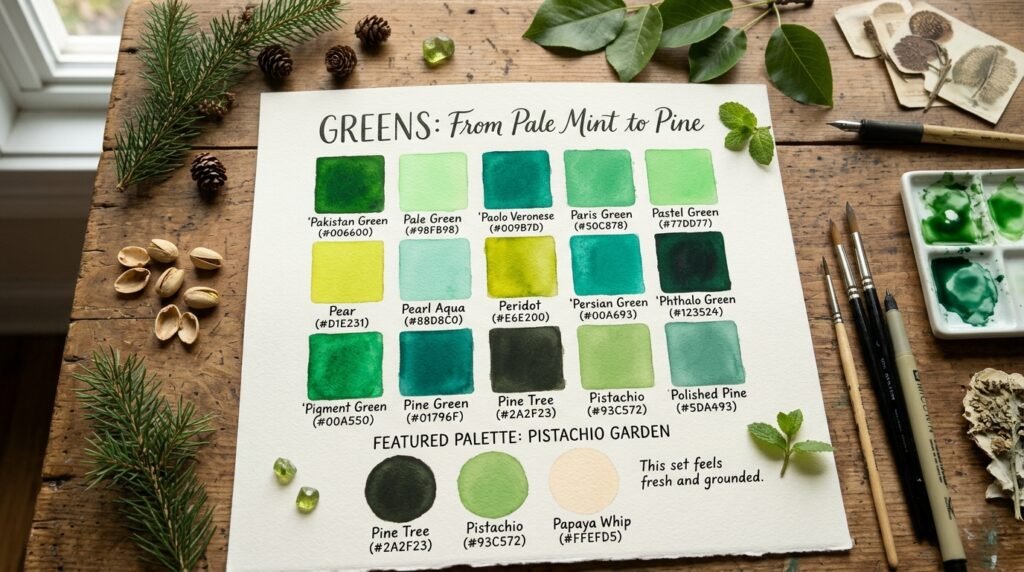
Fifteen greens fill this group. Pistachio is named for the nut. Peridot is named for the gemstone. Pine tree and Phthalo green are the darkest of them.
| Color | Hex | RGB | CMYK (approx.) | Quick note |
| Pakistan green | #006600 | 0, 102, 0 | 100, 0, 100, 60 | Pure dark green with no blue in it. White text scores 7.2:1. |
| Pale green | #98FB98 | 152, 251, 152 | 39, 0, 39, 2 | A CSS name. Fresh and minty. Black text scores 16.6:1. |
| Paolo Veronese green | #009B7D | 0, 155, 125 | 100, 0, 19, 39 | A cool, jewel-like emerald with a teal lean. Black text scores 6.0:1. |
| Paris Green | #50C878 | 80, 200, 120 | 60, 0, 40, 22 | A bright, clear emerald. Black text scores 9.9:1. |
| Pastel green | #77DD77 | 119, 221, 119 | 46, 0, 46, 13 | Soft and friendly. Black text scores 12.4:1. |
| Pear | #D1E231 | 209, 226, 49 | 8, 0, 78, 11 | Yellow-green with real zing. Black text scores 14.6:1. |
| Pearl aqua | #88D8C0 | 136, 216, 192 | 37, 0, 11, 15 | Gentle seafoam. Black text scores 12.6:1. |
| Peridot | #E6E200 | 230, 226, 0 | 0, 2, 100, 10 | Bright greenish yellow, named for the gemstone. Black text scores 15.2:1. |
| Persian green | #00A693 | 0, 166, 147 | 100, 0, 11, 35 | A clean teal-green that suits jewel palettes. Black text scores 6.9:1. |
| Phthalo green | #123524 | 18, 53, 36 | 66, 0, 32, 79 | Near-black forest green. White text scores 13.5:1. |
| Pigment green | #00A550 | 0, 165, 80 | 100, 0, 52, 35 | A true green with a slight blue lean. Black text scores 6.5:1. |
| Pine green | #01796F | 1, 121, 111 | 99, 0, 8, 53 | A deep teal. The blue side of green. White text scores 5.3:1. |
| Pine tree | #2A2F23 | 42, 47, 35 | 11, 0, 26, 82 | Almost black, with an olive tint. White text scores 13.7:1. |
| Pistachio | #93C572 | 147, 197, 114 | 25, 0, 42, 23 | Soft yellow-green, named for the nut. Black text scores 10.5:1. |
| Polished Pine | #5DA493 | 93, 164, 147 | 43, 0, 10, 36 | A muted sea-green. Black text scores 7.2:1. |
Pistachio Garden: Pine Tree, Pistachio, and Papaya Whip
#2A2F23, #93C572, and #FFEFD5. This set feels fresh and grounded. Pistachio on Pine tree scores 6.8:1. Papaya whip on Pine tree scores 12.1:1. Both pass the 4.5:1 test.
Peach, Yellow, and Orange: Fruit, Gold, and Warm Pastels

Twenty-one warm shades fill this group. Many take their names from fruit. Process yellow is named for the yellow ink used in process printing.
| Color | Hex | RGB | CMYK (approx.) | Quick note |
| Pale canary | #FFFF99 | 255, 255, 153 | 0, 0, 40, 0 | Light lemon yellow. Black text scores 20.0:1. |
| Pale copper | #DA8A67 | 218, 138, 103 | 0, 37, 53, 15 | A soft, terracotta-leaning peach. Black text scores 7.8:1. |
| Pale gold | #E6BE8A | 230, 190, 138 | 0, 17, 40, 10 | Sandy gold that tilts toward tan. Black text scores 12.1:1. |
| Pale goldenrod | #EEE8AA | 238, 232, 170 | 0, 3, 29, 7 | A CSS name. Muted butter yellow. Black text scores 16.8:1. |
| Pale spring bud | #ECEBBD | 236, 235, 189 | 0, 0, 20, 7 | Pale cream-yellow with a hint of green. Black text scores 17.2:1. |
| Paris Daisy | #FFF46E | 255, 244, 110 | 0, 4, 57, 0 | A cheerful, bright yellow. Black text scores 18.4:1. |
| Pastel orange | #FFB347 | 255, 179, 71 | 0, 30, 72, 0 | Warm apricot-orange. Black text scores 11.8:1. |
| Pastel yellow | #FDFD96 | 253, 253, 150 | 0, 0, 41, 1 | Soft, sunny lemon. Black text scores 19.7:1. |
| Peach | #FFE5B4 | 255, 229, 180 | 0, 10, 29, 0 | Pale and creamy, with a yellow lean. Black text scores 17.1:1. |
| Peach (Crayola) | #FFCBA4 | 255, 203, 164 | 0, 20, 36, 0 | Pinker and more apricot than plain Peach. Black text scores 14.3:1. |
| Peach puff | #FFDAB9 | 255, 218, 185 | 0, 15, 27, 0 | A CSS name that sits between the two peaches. Black text scores 16.0:1. |
| Peach-orange | #FFCC99 | 255, 204, 153 | 0, 20, 40, 0 | A light, creamsicle orange. Black text scores 14.3:1. |
| Peach-yellow | #FADFAD | 250, 223, 173 | 0, 11, 31, 2 | Pale golden cream. Black text scores 16.2:1. |
| Persian orange | #D99058 | 217, 144, 88 | 0, 34, 59, 15 | A burnt, clay-like orange. Black text scores 8.1:1. |
| Persimmon | #EC5800 | 236, 88, 0 | 0, 63, 100, 7 | Vivid red-orange. Black text scores 6.0:1. |
| Pink-orange | #FF9966 | 255, 153, 102 | 0, 40, 60, 0 | A salmon-like coral. Black text scores 10.0:1. |
| Portland Orange | #FF5A36 | 255, 90, 54 | 0, 65, 79, 0 | Hot red-orange. Black text scores 6.8:1. |
| Prairie gold | #E1CA7A | 225, 202, 122 | 0, 10, 46, 12 | Dusty wheat gold. Black text scores 12.9:1. |
| Princeton orange | #F58025 | 245, 128, 37 | 0, 48, 85, 4 | Bright orange tied to Princeton University. Black text scores 8.0:1. |
| Process yellow | #FFEF00 | 255, 239, 0 | 0, 6, 100, 0 | Pure bright yellow, like process-printing ink. Black text scores 17.6:1. |
| Pumpkin | #FF7518 | 255, 117, 24 | 0, 54, 91, 0 | A bright orange. Black text scores 7.8:1. |
Five Peaches
Five peach names sit side by side. Each one is a light, warm tint.
| Name | Hex | Look | Black text contrast |
| Peach | #FFE5B4 | Pale, creamy, yellow-leaning | 17.1:1 |
| Peach-yellow | #FADFAD | Pale golden cream | 16.2:1 |
| Peach puff | #FFDAB9 | Soft, pinkish peach | 16.0:1 |
| Peach (Crayola) | #FFCBA4 | Apricot, a little deeper | 14.3:1 |
| Peach-orange | #FFCC99 | Light creamsicle orange | 14.3:1 |
All five need black text. White text fails on every peach.
Navy and Ember: Prussian Blue, Princeton Orange, and Parchment
#003153, #F58025, and #F1E9D2. This set is bold and warm. Princeton orange on Prussian blue scores 5.1:1. Parchment on Prussian blue scores 11.1:1. Both pass the 4.5:1 test.
Reds and Berries: Crimsons, Plum-Reds, and Pomegranate
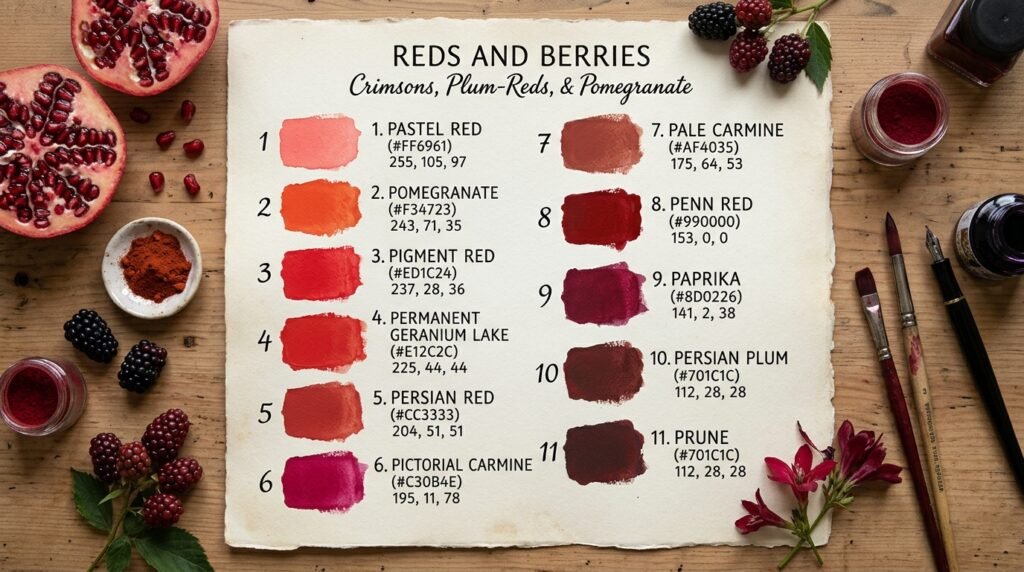
Eleven reds finish the warm side of the list. Two of them share one code. Persian plum and Prune are both #701C1C. Only the name changes.
| Color | Hex | RGB | CMYK (approx.) | Quick note |
| Pale carmine | #AF4035 | 175, 64, 53 | 0, 63, 70, 31 | A muted, brick-leaning red. White text scores 5.8:1. |
| Paprika | #8D0226 | 141, 2, 38 | 0, 99, 73, 45 | Dark berry red with a wine mood. White text scores 9.7:1. |
| Pastel red | #FF6961 | 255, 105, 97 | 0, 59, 62, 0 | Soft coral-red. Black text scores 7.4:1. |
| Penn red | #990000 | 153, 0, 0 | 0, 100, 100, 40 | A dark, pure red. White text scores 8.9:1. |
| Permanent Geranium Lake | #E12C2C | 225, 44, 44 | 0, 80, 80, 12 | Bright red with a slightly cool edge. Black text scores 4.6:1. |
| Persian plum | #701C1C | 112, 28, 28 | 0, 75, 75, 56 | Deep brownish red. Same code as Prune. White text scores 11.2:1. |
| Persian red | #CC3333 | 204, 51, 51 | 0, 75, 75, 20 | Medium brick red. White text scores 5.1:1. |
| Pictorial carmine | #C30B4E | 195, 11, 78 | 0, 94, 60, 24 | Crimson with raspberry notes. White text scores 6.0:1. |
| Pigment red | #ED1C24 | 237, 28, 36 | 0, 88, 85, 7 | A bright, near-primary red. Black text scores 4.8:1. |
| Pomegranate | #F34723 | 243, 71, 35 | 0, 71, 86, 5 | Fiery orange-red. Black text scores 5.7:1. |
| Prune | #701C1C | 112, 28, 28 | 0, 75, 75, 56 | Same code as Persian plum. White text scores 11.2:1. |
Neutrals and Earth Tones: Creams, Taupes, and Browns
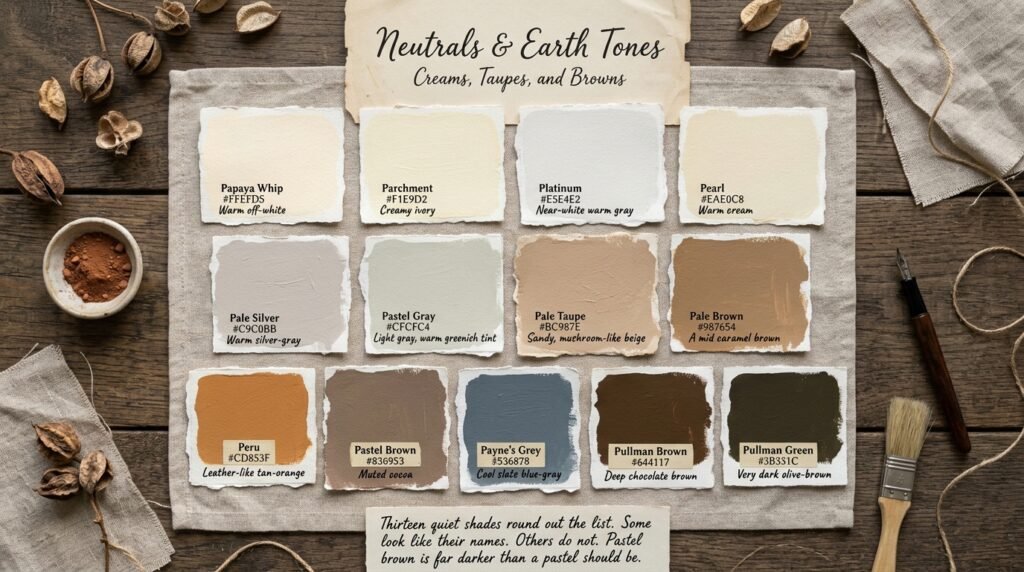
Thirteen quiet shades round out the list. Some look like their names. Others do not. Pastel brown is far darker than a pastel should be.
| Color | Hex | RGB | CMYK (approx.) | Quick note |
| Pale brown | #987654 | 152, 118, 84 | 0, 22, 45, 40 | A mid caramel brown. Black text scores 5.1:1. |
| Pale silver | #C9C0BB | 201, 192, 187 | 0, 4, 7, 21 | Warm silver-gray. Black text scores 11.7:1. |
| Pale taupe | #BC987E | 188, 152, 126 | 0, 19, 33, 26 | Sandy, mushroom-like beige. Black text scores 7.9:1. |
| Papaya whip | #FFEFD5 | 255, 239, 213 | 0, 6, 16, 0 | A CSS name. Warm off-white. Black text scores 18.6:1. |
| Parchment | #F1E9D2 | 241, 233, 210 | 0, 3, 13, 5 | Creamy ivory. Black text scores 17.3:1. |
| Pastel brown | #836953 | 131, 105, 83 | 0, 20, 37, 49 | A muted cocoa. Not very pastel. White text scores 5.1:1. |
| Pastel gray | #CFCFC4 | 207, 207, 196 | 0, 0, 5, 19 | Light gray with a warm, greenish tint. Black text scores 13.4:1. |
| Payne’s grey | #536878 | 83, 104, 120 | 31, 13, 0, 53 | Cool slate blue-gray. White text scores 5.8:1. |
| Pearl | #EAE0C8 | 234, 224, 200 | 0, 4, 15, 8 | Warm cream. Black text scores 16.0:1. |
| Peru | #CD853F | 205, 133, 63 | 0, 35, 69, 20 | A CSS name. Leather-like tan-orange. Black text scores 7.0:1. |
| Platinum | #E5E4E2 | 229, 228, 226 | 0, 0, 1, 10 | Near-white warm gray. Black text scores 16.5:1. |
| Pullman Brown (UPS Brown) | #644117 | 100, 65, 23 | 0, 35, 77, 61 | Deep chocolate brown. White text scores 9.1:1. |
| Pullman green | #3B331C | 59, 51, 28 | 0, 14, 53, 77 | Very dark olive-brown. White text scores 12.5:1. |
Which P Color Fits Your Job?
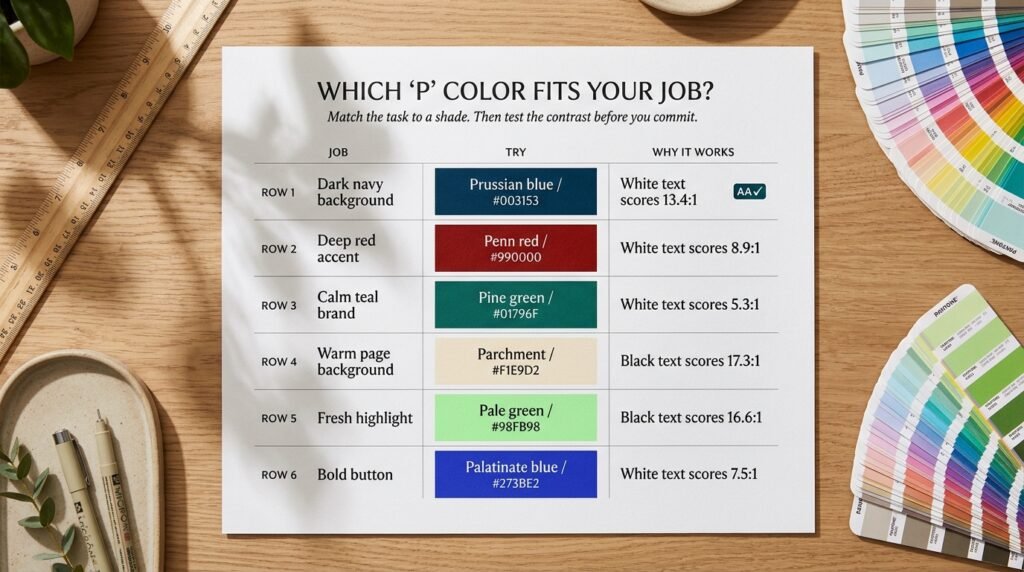
Match the task to a shade. Then test the contrast before you commit.
| Job | Try | Why it works |
| Dark navy background | Prussian blue #003153 | White text scores 13.4:1. |
| Deep red accent | Penn red #990000 | White text scores 8.9:1. |
| Calm teal brand | Pine green #01796F | White text scores 5.3:1. |
| Warm page background | Parchment #F1E9D2 | Black text scores 17.3:1. |
| Fresh highlight | Pale green #98FB98 | Black text scores 16.6:1. |
| Bold button | Palatinate blue #273BE2 | White text scores 7.5:1. |
Screen Codes vs. Print Codes
Hex and RGB suit screens. Screens mix red, green, and blue light. Hex is just RGB in a short form. The code #003153 means red 0, green 49, and blue 83.
CMYK suits print. Printers mix cyan, magenta, yellow, and black ink. Our CMYK values are rough. A simple formula made them. Real print results change with paper, ink, and profile.
Bright colors that start with P, like Persian rose and Phlox, often print duller. Ask your printer for a proof before a big run.
Put These P Colors to Work With Colorkahaar
Need help turning a shade into a full scheme? Colorkahaar can help. It offers color solutions for homes and businesses. It also offers color combinations for websites, apps, and logos. Pick a palette of colors that start with P. Then adapt it to your project.
How We Built This List
We built this list of colors that start with P from Wikipedia’s color lists, the CSS color names, and Crayola color names. Other lists may run longer. They often add variants that are hard to check. We chose truth over a bigger count.
Hex codes can differ by source. Treat each code as a good, common value. It is not the only one.
Frequently Asked Questions
How many colors start with P?
This guide lists 127. Longer lists may exist. Many add names nobody checked.
How many P colors are web colors?
There are 11. Four of them begin with the word Pale.
Why do some P colors share one code?
Persian plum and Prune are both #701C1C. Phlox and Psychedelic purple are both #DF00FF. The names differ, but the shades match.
Where does the word puce come from?
It comes from the French word for flea.
What are the darkest and lightest P colors?
Paua is the darkest, at #1F005E. Pale canary is the lightest, at #FFFF99.