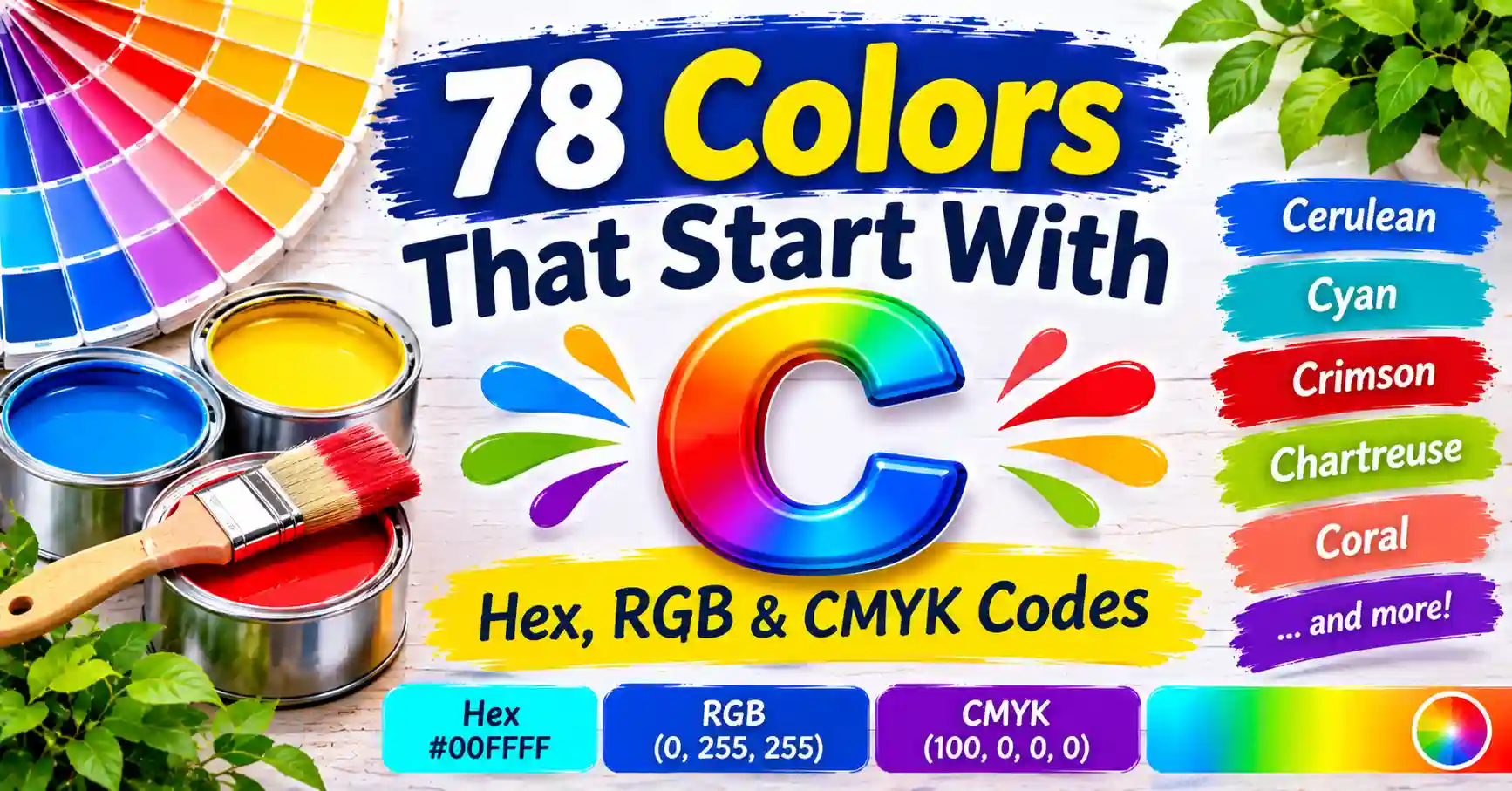
78 Colors That Start With C: Hex, RGB & CMYK Codes
The C in CMYK stands for cyan. Print shops use that ink every day. Yet cyan is only one of many colors that start with C. This guide lists 78 of them. Each one has a hex code, an RGB value, and a CMYK value. Every name comes from a real source. We did not invent shades or pad the list.
Here is the plan. We point out odd facts about the letter. We compare near twins. Then we build four ready palettes.
What Makes Colors That Start With C Unusual
Some letters give you pastels. Others give you jewels. The letter C gives you a little of everything. Still, five things set it apart.
C Is the Pigment Letter
Open an artist’s paint box. You will meet cadmium, cerulean, and cobalt. You will find carmine too. All four start with C. Each one began as a paint pigment. Cadmium paints are made with the metal cadmium. Cobalt blue is made with cobalt. Carmine comes from a tiny insect called the cochineal. That is why these names feel so old and so rich.
C Is Also the Food Letter
Say these names out loud. Café au lait, café noir. Champagne. Chocolate. Coconut. Coffee. Cream. Cosmic Latte. Cotton Candy. More than a dozen names here come from food or drink. That makes C a handy letter for menus, cafés, and bakery brands.
Many Names, One Color
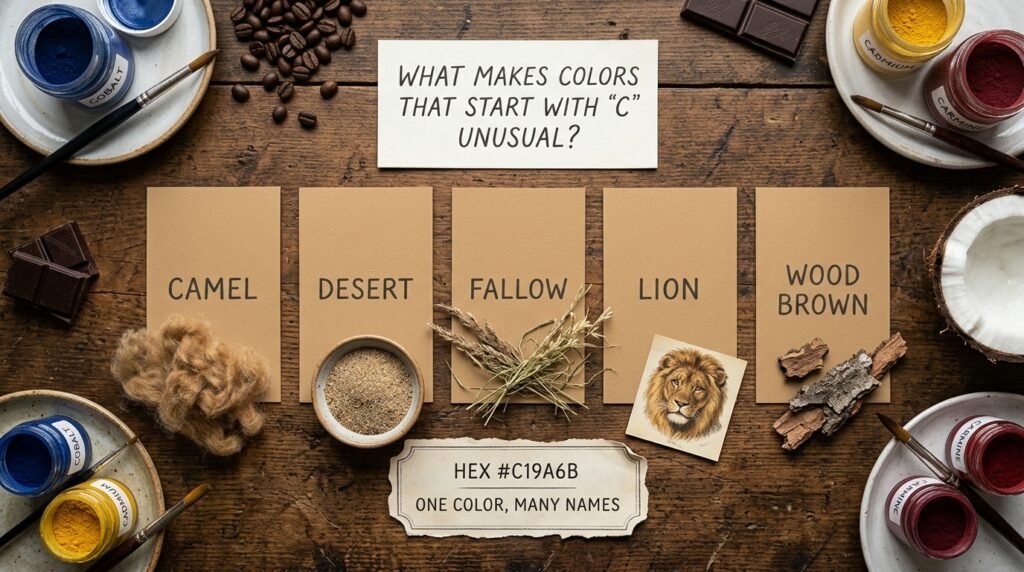
Names pile up fast in color lists. Camel is the champion. Four other names share its exact hex code. They are Desert, Fallow, Lion, and Wood Brown.
| Hex | C name | Other names with the same hex |
| #C19A6B | Camel | Desert, Fallow, Lion, Wood Brown |
| #A67B5B | Café au Lait | French Beige, Tuscan Tan |
| #F88379 | Congo Pink, Coral Pink | Tea Rose |
| #00FFFF | Cyan | Aqua, Spanish Sky Blue |
| #B2FFFF | Celeste | Italian Sky Blue |
| #D2691E | Chocolate (web) | Cocoa Brown |
| #F5F5F5 | Cultured | White Smoke |
| #93CCEA | Cornflower Blue (Crayola) | Light Cornflower Blue |
| #FFD300 | Cyber Yellow | Yellow (NCS) |
So a name is not always a unique color. Often it is just a label. When two names share a code, pick the one your audience knows best.
Chocolate Does Not Look Like Chocolate
CSS has a color named chocolate. Its code is #D2691E. That shade is a bright orange-brown. It looks more like cinnamon than candy. The traditional chocolate shade is #7B3F00. It is much darker. You will find a side-by-side later in the browns section.
Only Eight Are Web Colors
CSS keeps a short list of named colors. Only eight of them start with C. They are Cadet Blue, Chartreuse, Chocolate, Coral, Cornflower Blue, Cornsilk, Crimson, and Cyan. Every other name here comes from paint, pigments, schools, or crayon makers.
Quick A–Z Index of All 78 Colors
Use this table to find any shade fast. It shows hex codes only. Full details follow, grouped by family.
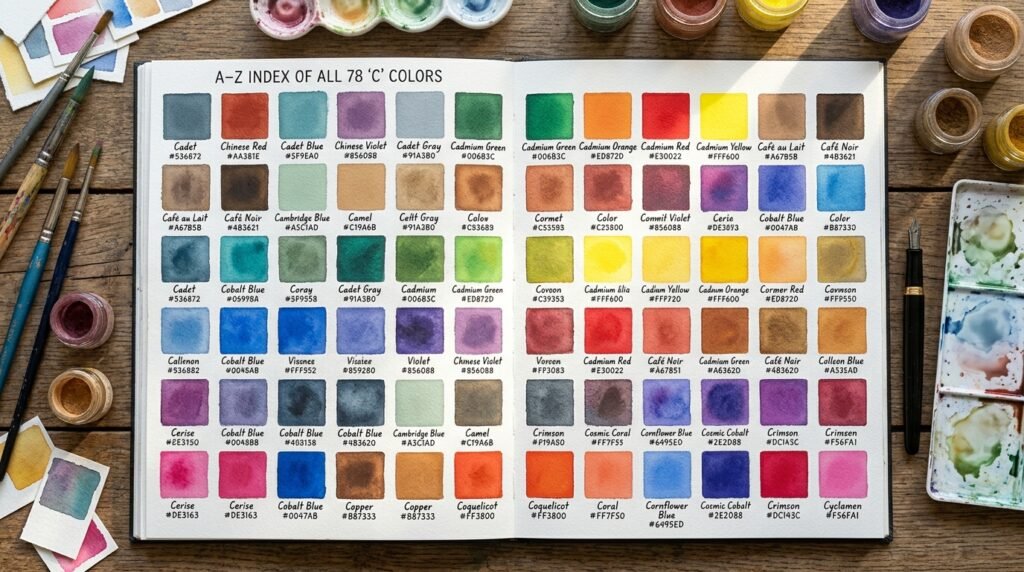
| Color | Hex | Color | Hex |
| Cadet | #536872 | Chinese Red | #AA381E |
| Cadet Blue | #5F9EA0 | Chinese Violet | #856088 |
| Cadet Gray | #91A3B0 | Chocolate (traditional) | #7B3F00 |
| Cadmium Green | #006B3C | Chocolate (web) | #D2691E |
| Cadmium Orange | #ED872D | Cinereous | #98817B |
| Cadmium Red | #E30022 | Cinnamon Satin | #CD607E |
| Cadmium Yellow | #FFF600 | Citrine | #E4D00A |
| Café au Lait | #A67B5B | Citron | #9FA91F |
| Café Noir | #4B3621 | Claret | #7F1734 |
| Cambridge Blue | #A3C1AD | Cloud | #EFF1FE |
| Camel | #C19A6B | Cobalt Blue | #0047AB |
| Cameo Pink | #EFBBCC | Coconut | #965A3E |
| Canary | #FFFF99 | Coffee | #6F4E37 |
| Canary Yellow | #FFEF00 | Columbia Blue | #9BDDFF |
| Candy Apple Red | #FF0800 | Congo Pink | #F88379 |
| Candy Pink | #E4717A | Cool Gray | #8C92AC |
| Cardinal | #C41E3A | Copper | #B87333 |
| Caribbean Green | #00CC99 | Copper Penny | #AD6F69 |
| Carmine | #960018 | Copper Red | #CB6D51 |
| Carnation Pink | #FFA6C9 | Copper Rose | #996666 |
| Carolina Blue | #99BADD | Coquelicot | #FF3800 |
| Carrot Orange | #ED9121 | Coral | #FF7F50 |
| Catawba | #703642 | Coral Pink | #F88379 |
| Celadon | #ACE1AF | Cordovan | #893F45 |
| Celeste | #B2FFFF | Cornflower Blue (Crayola) | #93CCEA |
| Cerise | #DE3163 | Cornflower Blue (web) | #6495ED |
| Cerulean | #007BA7 | Cornsilk | #FFF8DC |
| Cerulean (Crayola) | #1DACD6 | Cosmic Cobalt | #2E2D88 |
| Cerulean Blue | #2A52BE | Cosmic Latte | #FFF8E7 |
| Cerulean Frost | #6D9BC3 | Cotton Candy | #FFBCD9 |
| Champagne | #FAD6A5 | Coyote Brown | #81613C |
| Champagne Pink | #F1DDCF | Cream | #FFFDD0 |
| Charcoal | #36454F | Crimson | #DC143C |
| Charleston Green | #232B2B | Crimson (UA) | #9E1B32 |
| Charm Pink | #E68FAC | Cultured | #F5F5F5 |
| Chartreuse | #7FFF00 | Cyan | #00FFFF |
| Cherry Blossom Pink | #FFB7C5 | Cyber Grape | #58427C |
| Chestnut | #954535 | Cyber Yellow | #FFD300 |
| China Pink | #DE6FA1 | Cyclamen | #F56FA1 |
Blues and Cyans: The Biggest Family
Blue wins by count. Fifteen of the 78 colors that start with C sit in this family. They run from pale ice to deep ink. Cyan sits at the bright end. Cosmic Cobalt sits at the dark end.

| Color | Hex | RGB | CMYK (approx.) | Quick note |
| Cadet | #536872 | 83, 104, 114 | 27, 9, 0, 55 | A deep blue-gray. Softer than black for text. White on it scores 5.8:1. |
| Cadet Blue | #5F9EA0 | 95, 158, 160 | 41, 1, 0, 37 | Soft gray-teal. Calm and quiet. It is one of the eight CSS color names. |
| Cadet Gray | #91A3B0 | 145, 163, 176 | 18, 7, 0, 31 | Cool gray with a blue lean. Good for borders and muted panels. |
| Carolina Blue | #99BADD | 153, 186, 221 | 31, 16, 0, 13 | Light sky blue. It is linked to the University of North Carolina. |
| Celeste | #B2FFFF | 178, 255, 255 | 30, 0, 0, 0 | A pale, glassy aqua. Use it as a soft backdrop, never as text. |
| Cerulean | #007BA7 | 0, 123, 167 | 100, 26, 0, 35 | Deep sky blue with a green touch. White text passes at 4.8:1. |
| Cerulean Blue | #2A52BE | 42, 82, 190 | 78, 57, 0, 25 | Darker and richer than plain cerulean. It leans toward royal blue. |
| Cerulean Frost | #6D9BC3 | 109, 155, 195 | 44, 21, 0, 24 | A dusty blue. Think faded denim. |
| Cerulean (Crayola) | #1DACD6 | 29, 172, 214 | 86, 20, 0, 16 | The bright crayon-box take. Cheerful and punchy. |
| Cobalt Blue | #0047AB | 0, 71, 171 | 100, 58, 0, 33 | Strong, deep blue. The pigment is made with cobalt. Sharp on cream. |
| Columbia Blue | #9BDDFF | 155, 221, 255 | 39, 13, 0, 0 | Light and airy. It is linked to Columbia University. |
| Cornflower Blue (web) | #6495ED | 100, 149, 237 | 58, 37, 0, 7 | Named for the flower. A friendly mid-blue for links and buttons. |
| Cornflower Blue (Crayola) | #93CCEA | 147, 204, 234 | 37, 13, 0, 8 | A paler crayon version. Close to a clear morning sky. |
| Cosmic Cobalt | #2E2D88 | 46, 45, 136 | 66, 67, 0, 47 | Deep blue with an indigo lean. White text scores a strong 11.4:1. |
| Cyan | #00FFFF | 0, 255, 255 | 100, 0, 0, 0 | Pure screen cyan. It is also the C in CMYK. |
Four Ceruleans Side by Side
Cerulean shows up four times. The name points to a sky blue. Yet the codes differ a lot.
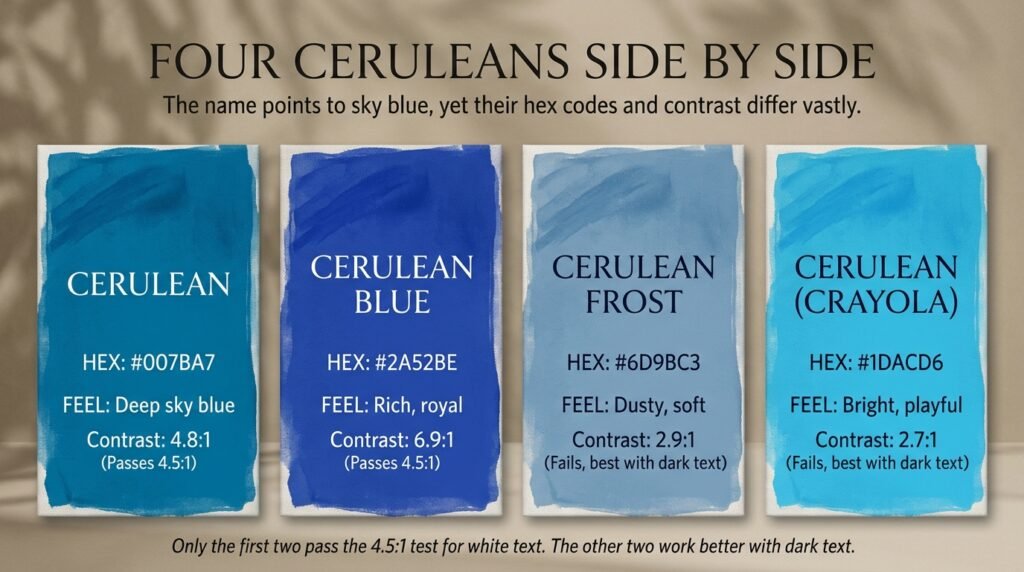
| Name | Hex | Feel | White text contrast |
| Cerulean | #007BA7 | Deep sky blue | 4.8:1 |
| Cerulean Blue | #2A52BE | Rich, royal | 6.9:1 |
| Cerulean Frost | #6D9BC3 | Dusty, soft | 2.9:1 |
| Cerulean (Crayola) | #1DACD6 | Bright, playful | 2.7:1 |
Only the first two pass the 4.5:1 test for white text. The other two work better with dark text.
Greens: Few but Bold
Greens are rare in this letter. Only five made the cut. Yet they cover a lot of ground. One is as deep as pine.
| Color | Hex | RGB | CMYK (approx.) | Quick note |
| Cadmium Green | #006B3C | 0, 107, 60 | 100, 0, 44, 58 | A deep, steady green. Think pine in shade. |
| Cambridge Blue | #A3C1AD | 163, 193, 173 | 16, 0, 10, 24 | The name says blue. The code says gray-green. It is tied to Cambridge University. |
| Caribbean Green | #00CC99 | 0, 204, 153 | 100, 0, 25, 20 | Bright mint-teal. Best in small, lively doses. |
| Celadon | #ACE1AF | 172, 225, 175 | 24, 0, 22, 12 | Pale and fresh. It is also the name of a pottery glaze. |
| Chartreuse | #7FFF00 | 127, 255, 0 | 50, 0, 100, 0 | Loud yellow-green. The name comes from a French liqueur. |
Cambridge Blue is the odd one out. Its name says blue. Its code says gray-green.
Reds: From Poppy to Wine
Twelve reds fill this family. Some glow. Some are dark as wine. Most carry a long history in paint and dye.
| Color | Hex | RGB | CMYK (approx.) | Quick note |
| Cadmium Red | #E30022 | 227, 0, 34 | 0, 100, 85, 11 | A hot, true red. A classic tube-paint pigment. |
| Candy Apple Red | #FF0800 | 255, 8, 0 | 0, 97, 100, 0 | Near-pure red with a glossy feel. The name is common in car paint. |
| Cardinal | #C41E3A | 196, 30, 58 | 0, 85, 70, 23 | Deep, rich red. It is linked to the robes of cardinals. |
| Carmine | #960018 | 150, 0, 24 | 0, 100, 84, 41 | Dark and blood-toned. The pigment comes from cochineal insects. |
| Catawba | #703642 | 112, 54, 66 | 0, 52, 41, 56 | Dark wine with a purple tinge. Moody and rich. |
| Cerise | #DE3163 | 222, 49, 99 | 0, 78, 55, 13 | French for cherry. A bold cherry-pink red. |
| Chinese Red | #AA381E | 170, 56, 30 | 0, 67, 82, 33 | A rusty red-brown. Warm and earthy. |
| Claret | #7F1734 | 127, 23, 52 | 0, 82, 59, 50 | Dark and winey. It is named for a red Bordeaux wine. |
| Coquelicot | #FF3800 | 255, 56, 0 | 0, 78, 100, 0 | French for the wild poppy. A fiery red-orange. |
| Cordovan | #893F45 | 137, 63, 69 | 0, 54, 50, 46 | Burgundy-brown, like polished leather shoes. |
| Crimson | #DC143C | 220, 20, 60 | 0, 91, 73, 14 | Vivid red with a slight pink edge. One of the eight CSS names. |
| Crimson (UA) | #9E1B32 | 158, 27, 50 | 0, 83, 68, 38 | A deeper crimson. It is tied to the University of Alabama. |
Four Deep Reds, Ranked
These four are easy to mix up. Line them up by darkness, and the gap is clear.
| Name | Hex | Mood | White text contrast |
| Crimson | #DC143C | Bright, pink-tinged | 5.0:1 |
| Cardinal | #C41E3A | Deep, formal | 5.8:1 |
| Carmine | #960018 | Dark, blood-toned | 9.1:1 |
| Claret | #7F1734 | Winey, almost plum | 10.1:1 |
All four pass the 4.5:1 test with white text. Crimson passes only by a small margin.
Pinks and Corals
Pinks run wide here. Cotton Candy is playful. Cameo Pink is quiet. Coral is bold. Pick by mood, then test the contrast.
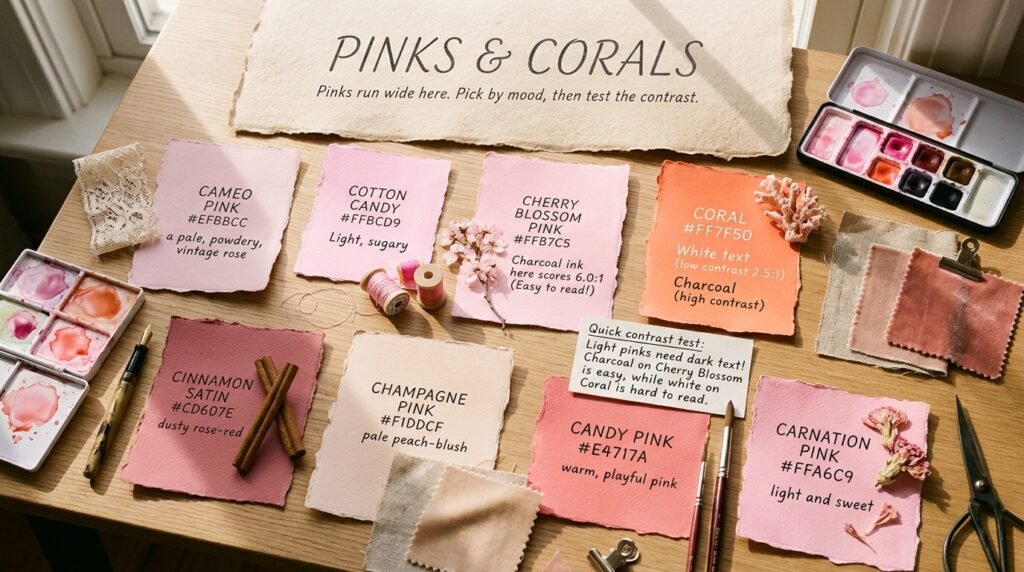
| Color | Hex | RGB | CMYK (approx.) | Quick note |
| Cameo Pink | #EFBBCC | 239, 187, 204 | 0, 22, 15, 6 | Pale, powdery rose. Soft, quiet, and a bit vintage. |
| Candy Pink | #E4717A | 228, 113, 122 | 0, 50, 46, 11 | Warm pink with a coral touch. Playful, not neon. |
| Carnation Pink | #FFA6C9 | 255, 166, 201 | 0, 35, 21, 0 | Light and sweet, like the flower of the same name. |
| Champagne Pink | #F1DDCF | 241, 221, 207 | 0, 8, 14, 5 | A pale peach-blush. Almost a neutral. |
| Charm Pink | #E68FAC | 230, 143, 172 | 0, 38, 25, 10 | A gentle mid-pink. Friendly on packaging. |
| Cherry Blossom Pink | #FFB7C5 | 255, 183, 197 | 0, 28, 23, 0 | Light spring pink. Lovely with soft gray. |
| China Pink | #DE6FA1 | 222, 111, 161 | 0, 50, 27, 13 | A rosy pink with a purple lean. |
| Cinnamon Satin | #CD607E | 205, 96, 126 | 0, 53, 39, 20 | Dusty rose-red. Warm without feeling loud. |
| Congo Pink | #F88379 | 248, 131, 121 | 0, 47, 51, 3 | Salmon-coral. It shares its hex with Coral Pink. |
| Coral | #FF7F50 | 255, 127, 80 | 0, 50, 69, 0 | Bright orange-pink. A CSS name. White text on it scores just 2.5:1. |
| Coral Pink | #F88379 | 248, 131, 121 | 0, 47, 51, 3 | Same hex as Congo Pink. Two names, one color. |
| Cotton Candy | #FFBCD9 | 255, 188, 217 | 0, 26, 15, 0 | Light and sugary. Reads fun and young. |
| Cyclamen | #F56FA1 | 245, 111, 161 | 0, 55, 34, 4 | A bold, bright pink with a purple edge. |
Light pinks need dark text. Charcoal on Cherry Blossom Pink scores about 6.0:1. That is easy to read. Champagne Pink also sits close to nude tones.
Oranges and Yellows
Eight bright shades live here. They grab the eye fast. They also give little contrast on white. Cyber Yellow on white scores just 1.4:1. Pair these colors with deep purple or navy instead.
| Color | Hex | RGB | CMYK (approx.) | Quick note |
| Cadmium Orange | #ED872D | 237, 135, 45 | 0, 43, 81, 7 | Bright pumpkin orange. Striking next to deep blue. |
| Cadmium Yellow | #FFF600 | 255, 246, 0 | 0, 4, 100, 0 | Very bright lemon yellow. It needs dark text on top. |
| Canary | #FFFF99 | 255, 255, 153 | 0, 0, 40, 0 | Pale butter yellow. Gentle on large backgrounds. |
| Canary Yellow | #FFEF00 | 255, 239, 0 | 0, 6, 100, 0 | Intense, sunny yellow. Also known as process yellow. |
| Carrot Orange | #ED9121 | 237, 145, 33 | 0, 39, 86, 7 | Warm orange that reads just like the vegetable. |
| Citrine | #E4D00A | 228, 208, 10 | 0, 9, 96, 11 | Golden lemon. The name comes from a yellow quartz gem. |
| Citron | #9FA91F | 159, 169, 31 | 6, 0, 82, 34 | Olive-leaning yellow-green. Earthy and a little sour. |
| Cyber Yellow | #FFD300 | 255, 211, 0 | 0, 17, 100, 0 | Rich golden yellow. Strong beside deep purple. |
Browns and Coppers: The Warm Earth Tones
Thirteen browns sit in this family. Four of them are copper shades. The rest range from café brown to chestnut.
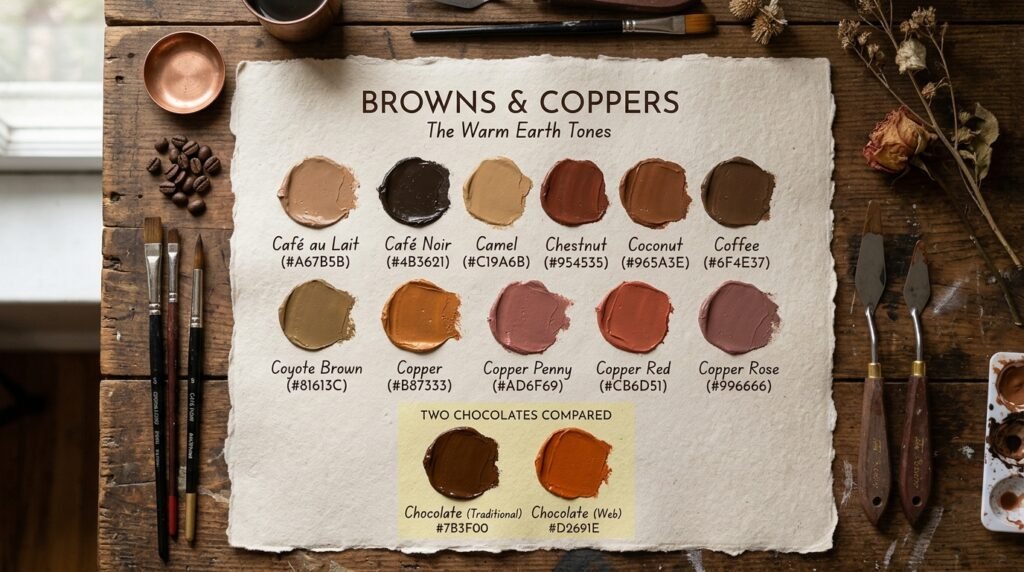
| Color | Hex | RGB | CMYK (approx.) | Quick note |
| Café au Lait | #A67B5B | 166, 123, 91 | 0, 26, 45, 35 | Milky coffee brown. It shares its hex with French Beige and Tuscan Tan. |
| Café Noir | #4B3621 | 75, 54, 33 | 0, 28, 56, 71 | Very dark brown, like espresso. Warmer than black. |
| Camel | #C19A6B | 193, 154, 107 | 0, 20, 45, 24 | Sandy tan. Five names share this exact hex. |
| Chestnut | #954535 | 149, 69, 53 | 0, 54, 64, 42 | Reddish brown with real warmth. |
| Chocolate (traditional) | #7B3F00 | 123, 63, 0 | 0, 49, 100, 52 | Dark, rich brown that looks like a real chocolate bar. |
| Chocolate (web) | #D2691E | 210, 105, 30 | 0, 50, 86, 18 | Orange-brown. It looks more like cinnamon than candy. |
| Coconut | #965A3E | 150, 90, 62 | 0, 40, 59, 41 | Warm mid-brown. Think husk, not flesh. |
| Coffee | #6F4E37 | 111, 78, 55 | 0, 30, 50, 56 | Medium-dark brown. Great text color on Cosmic Latte at 7.0:1. |
| Copper | #B87333 | 184, 115, 51 | 0, 38, 72, 28 | Metal-like orange-brown. On screen, it stays flat, not shiny. |
| Copper Penny | #AD6F69 | 173, 111, 105 | 0, 36, 39, 32 | Dusty red-brown with a pink tinge. |
| Copper Red | #CB6D51 | 203, 109, 81 | 0, 46, 60, 20 | A brighter, rustier copper. Close to terracotta. |
| Copper Rose | #996666 | 153, 102, 102 | 0, 33, 33, 40 | Muted and rosy. Soft and dusty. |
| Coyote Brown | #81613C | 129, 97, 60 | 0, 25, 53, 49 | Dull tan-brown with an olive cast. |
Two Chocolates Compared
Here is the odd pair from earlier. Both carry the same name. They look nothing alike.
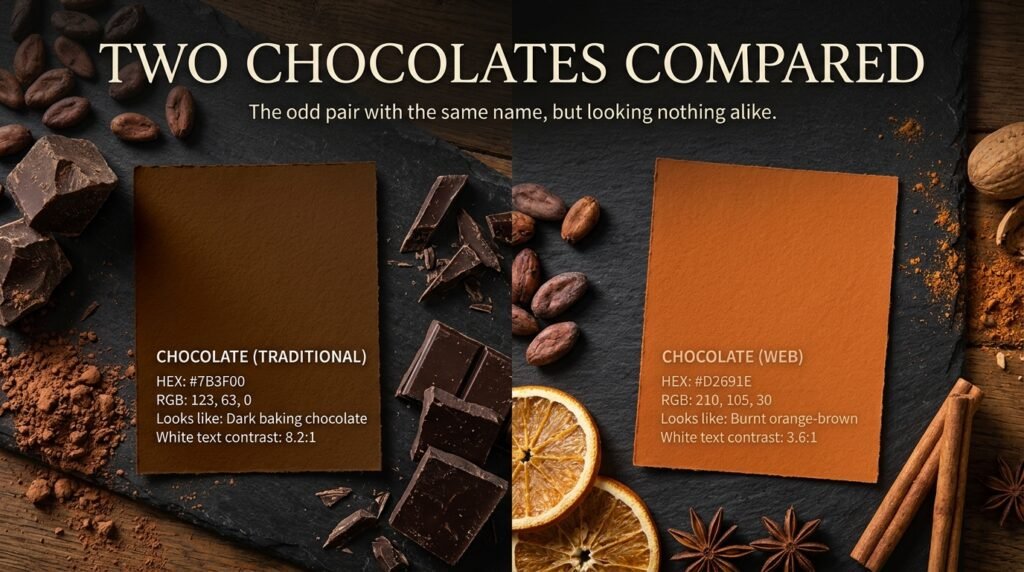
| Name | Hex | RGB | Looks like | White text contrast |
| Chocolate (traditional) | #7B3F00 | 123, 63, 0 | Dark baking chocolate | 8.2:1 |
| Chocolate (web) | #D2691E | 210, 105, 30 | Burnt orange-brown | 3.6:1 |
Want a Camel-like tan in paint? Start with a sand base. Our guide shows the steps.
Neutrals, Creams, and Grays
Ten quiet shades close the main list. Some are warm. Some are cool. A few look nearly white.
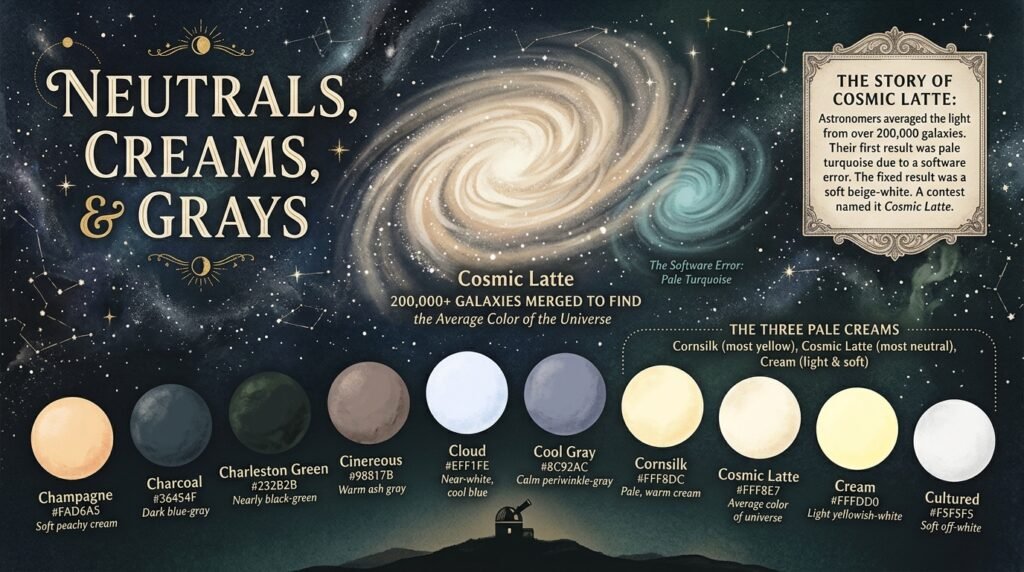
| Color | Hex | RGB | CMYK (approx.) | Quick note |
| Champagne | #FAD6A5 | 250, 214, 165 | 0, 14, 34, 2 | Soft peachy cream. Warm and light. |
| Charcoal | #36454F | 54, 69, 79 | 32, 13, 0, 69 | Dark blue-gray. Softer than black. White on it scores 9.9:1. |
| Charleston Green | #232B2B | 35, 43, 43 | 19, 0, 0, 83 | Looks nearly black. A hint of green hides inside. |
| Cinereous | #98817B | 152, 129, 123 | 0, 15, 19, 40 | Warm ash gray with a brown cast. |
| Cloud | #EFF1FE | 239, 241, 254 | 6, 5, 0, 0 | Near-white with a cool blue tint. Fine for page backgrounds. |
| Cool Gray | #8C92AC | 140, 146, 172 | 19, 15, 0, 33 | Gray with a periwinkle lean. Calm and modern. |
| Cornsilk | #FFF8DC | 255, 248, 220 | 0, 3, 14, 0 | Pale, warm cream. One of the eight CSS names. |
| Cosmic Latte | #FFF8E7 | 255, 248, 231 | 0, 3, 9, 0 | The estimated average color of the universe. |
| Cream | #FFFDD0 | 255, 253, 208 | 0, 1, 18, 0 | Light yellowish white. Warmer and softer than pure white. |
| Cultured | #F5F5F5 | 245, 245, 245 | 0, 0, 0, 4 | Soft off-white. Same hex as White Smoke. |
Three of them look alike at first glance. Cornsilk, Cosmic Latte, and Cream are all pale and warm. Cream has the least blue in its code, so it looks the most yellow. Cosmic Latte has the most blue, so it looks the most neutral.
The Story of Cosmic Latte
Cosmic Latte has the best backstory on this list. Astronomers averaged the light from more than 200,000 galaxies. Their first result was a pale turquoise. Then they found a software error. The fixed result was a soft beige-white. The team held a contest to name it. Cosmic Latte won.
Purples: A Small Corner
Only two purples start with C. Cyber Grape is deep and bluish. Chinese Violet is dusty and soft.
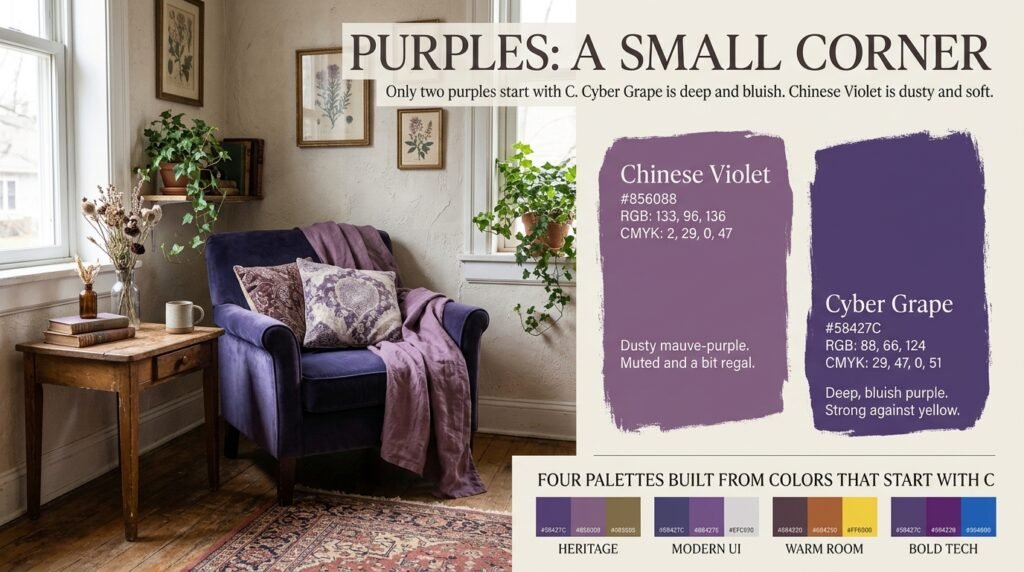
| Color | Hex | RGB | CMYK (approx.) | Quick note |
| Chinese Violet | #856088 | 133, 96, 136 | 2, 29, 0, 47 | Dusty mauve-purple. Muted and a bit regal. |
| Cyber Grape | #58427C | 88, 66, 124 | 29, 47, 0, 51 | Deep, bluish purple. Strong against yellow. |
Four Palettes Built From Colors That Start With C
One color helps. A set helps more. Here are four sets. Each uses colors that start with C from this list. Contrast numbers use the WCAG formula. Higher numbers mean easier reading.
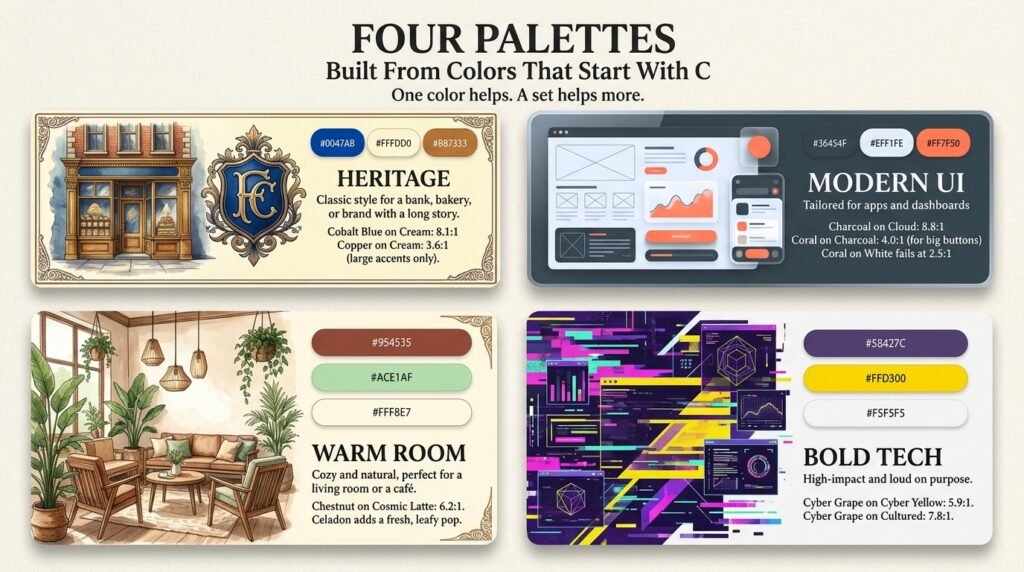
Heritage: Cobalt Blue, Cream, and Copper
#0047AB, #FFFDD0, and #B87333. This trio feels classic. It suits a bank, a bakery, or a brand with a long story. Cobalt Blue on Cream scores 8.1:1. Copper on Cream scores 3.6:1. So use copper for large accents only.
Modern UI: Charcoal, Cloud, and Coral
#36454F, #EFF1FE, and #FF7F50. This set suits apps and dashboards. Charcoal on Cloud scores 8.8:1. Coral on Charcoal scores 4.0:1, which works for big buttons. Coral on white fails at 2.5:1.
Warm Room: Chestnut, Celadon, and Cosmic Latte
#954535, #ACE1AF, and #FFF8E7. This set suits a living room or a café. Chestnut on Cosmic Latte scores 6.2:1. Celadon adds a fresh, leafy pop.
Bold Tech: Cyber Grape, Cyber Yellow, and Cultured
#58427C, #FFD300, and #F5F5F5. This set is loud on purpose. Cyber Grape on Cyber Yellow scores 5.9:1. Cyber Grape on Cultured scores 7.8:1.
Which C Color Fits Your Project?
Not sure where to start? Match your goal to a shade. Then test the contrast before you commit.
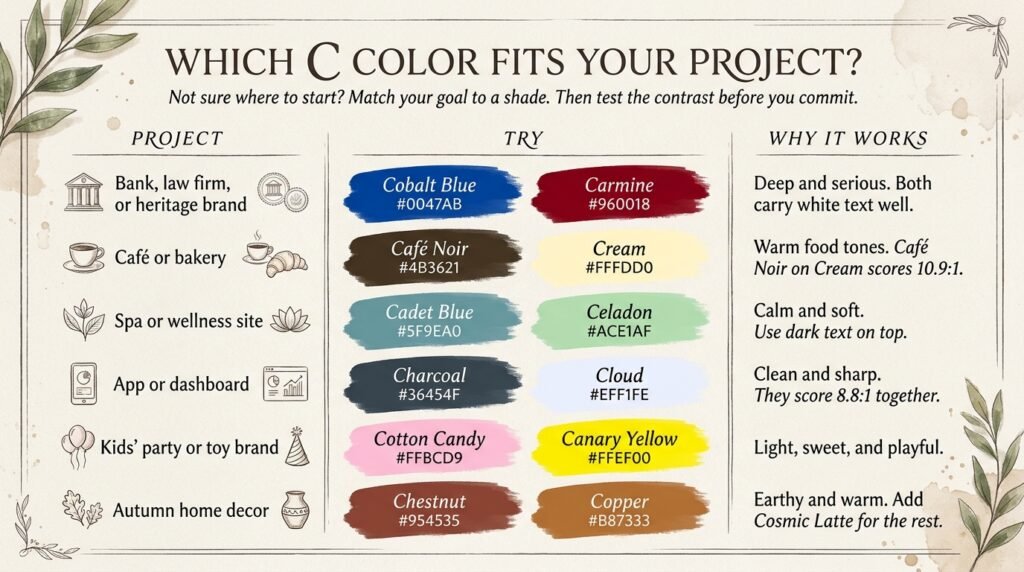
| Project | Try | Why it works |
| Bank, law firm, or heritage brand | Cobalt Blue #0047AB, Carmine #960018 | Deep and serious. Both carry white text well. |
| Café or bakery | Café Noir #4B3621, Cream #FFFDD0 | Warm food tones. Café Noir on Cream scores 10.9:1. |
| Spa or wellness site | Cadet Blue #5F9EA0, Celadon #ACE1AF | Calm and soft. Use dark text on top. |
| App or dashboard | Charcoal #36454F, Cloud #EFF1FE | Clean and sharp. They score 8.8:1 together. |
| Kids’ party or toy brand | Cotton Candy #FFBCD9, Canary Yellow #FFEF00 | Light, sweet, and playful. |
| Autumn home decor | Chestnut #954535, Copper #B87333 | Earthy and warm. Add Cosmic Latte for the rest. |
Screen Codes vs. Print Codes
Hex and RGB are for screens. Screens mix red, green, and blue light. Hex is just RGB in a short form. The code #00FFFF means red 0, green 255, and blue 255.
CMYK is for print. Printers mix cyan, magenta, yellow, and black ink. The CMYK values here are approximate. They come from a simple math formula. Real print results depend on paper, ink, and profile.
Bright screen colors such as Cyan and Chartreuse often print duller. Ask your printer for a proof before a big run.
How We Built This List
We started with the Wikipedia list of colors. We matched the web colors to the CSS color keywords. Hex codes can differ by source. Treat each code as a good, common value. It is not the only one.
Frequently Asked Questions
How many colors start with C?
This guide lists 78. Longer lists exist. But many add invented names or repeats.
Which C colors are web colors?
Eight. They are Cadet Blue, Chartreuse, Chocolate, Coral, Cornflower Blue, Cornsilk, Crimson, and Cyan.
Is cyan the same as aqua?
On screens, yes. Both use #00FFFF.
What is the darkest color that starts with C?
Charleston Green, at #232B2B. It looks nearly black.